Document
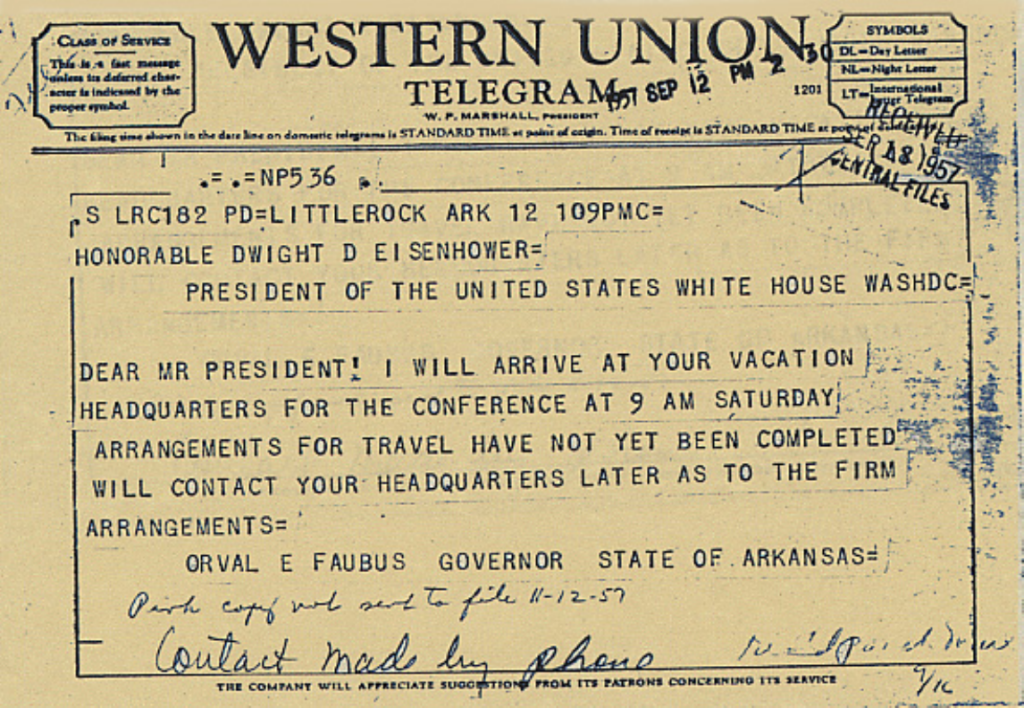
Governor Orval Faubus’s Telegram Accepting President Eisenhower’s Invitation to Meet on Little Rock Crisis(1957)
Key Details
Date: September 12, 1957
Created By: Orval Faubus
Original or Replica: Original
Era: The Presidency, Civil Rights
Collection: Eisenhower Presidential Library
Citations: DDE’s Records as President, Official File, Box 615, OF 142-A-5-A (1); NAID #12237653
About
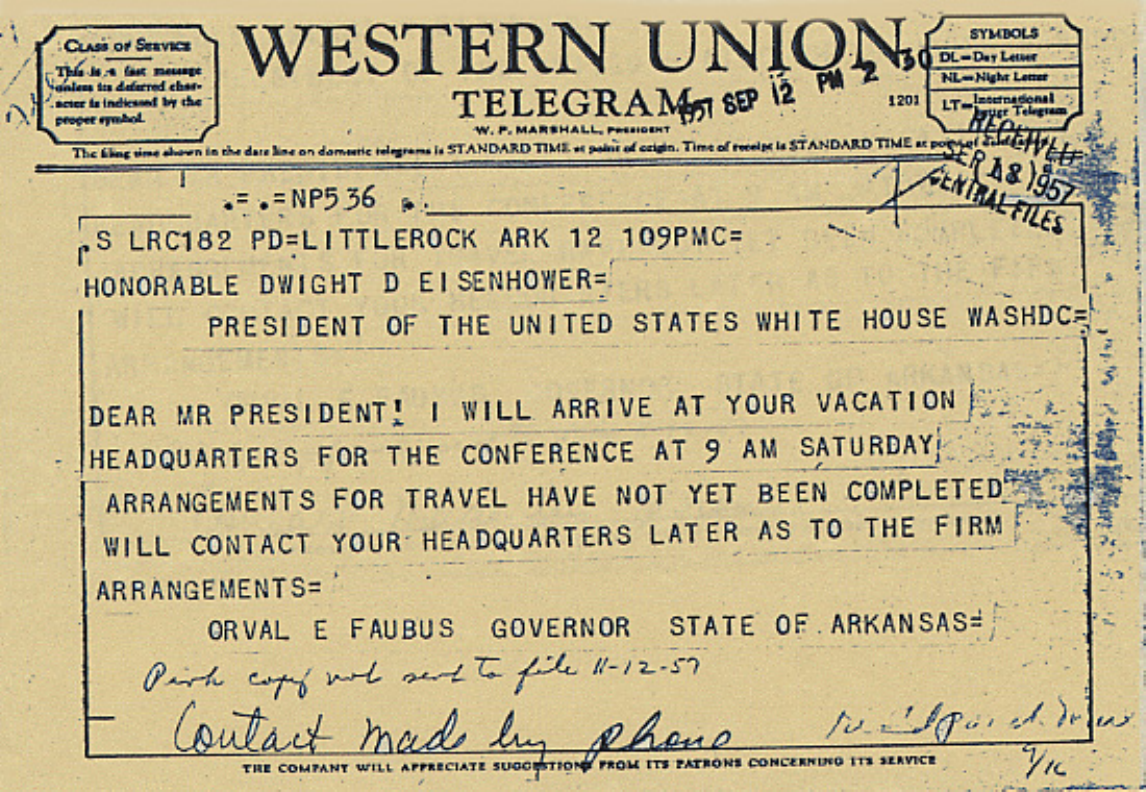
This document is a Western Union telegram sent by Governor Orval E. Faubus of Arkansas to President Dwight D. Eisenhower on September 12, 1957. In the telegram, Governor Faubus accepts President Eisenhower’s invitation to meet at the President’s vacation headquarters in Newport, Rhode Island, on the morning of September 14, 1957, to discuss the growing crisis surrounding the court-ordered integration of Little Rock Central High School.
Although brief, the telegram marks an important step in the communications between the White House and the Arkansas governor during the Little Rock Crisis. Faubus informs the President that he will attend the conference as scheduled and notes that his travel arrangements are still being finalized. The meeting, requested by President Eisenhower, was intended to resolve the escalating conflict over the enforcement of federal court orders and to determine whether the crisis could be settled peacefully through cooperation between the federal government and the State of Arkansas.
The Newport meeting became one of the most significant diplomatic exchanges of the Little Rock Crisis. President Eisenhower left the conference believing that Governor Faubus had agreed to comply with the federal courts and preserve law and order. However, those expectations quickly unraveled, and within days the situation in Little Rock deteriorated, ultimately leading President Eisenhower to issue Proclamation 3204 and Executive Order 10730, federalize the Arkansas National Guard, and deploy the 101st Airborne Division to enforce school integration.
Used In These Lessons & Programs
Bring History to Life
Join us for engaging learning experiences designed for young minds.