Document
Eisenhower Administration Makes the Case for Immediate Hawaiian Statehood Before Congress (1957)
Key Details
Date: April 2, 1957
Created By: Fred A. Seaton, Secretary of the Interior
Original or Replica: Original
Era: The Presidency, Alaska & Hawaii Statehood
Collection: Eisenhower Presidential Library
Citations: DDE’s Records as President, Official File, Box 632, OF-147-E-1, Hawaiian Statehood (1); NAID #16607081
About
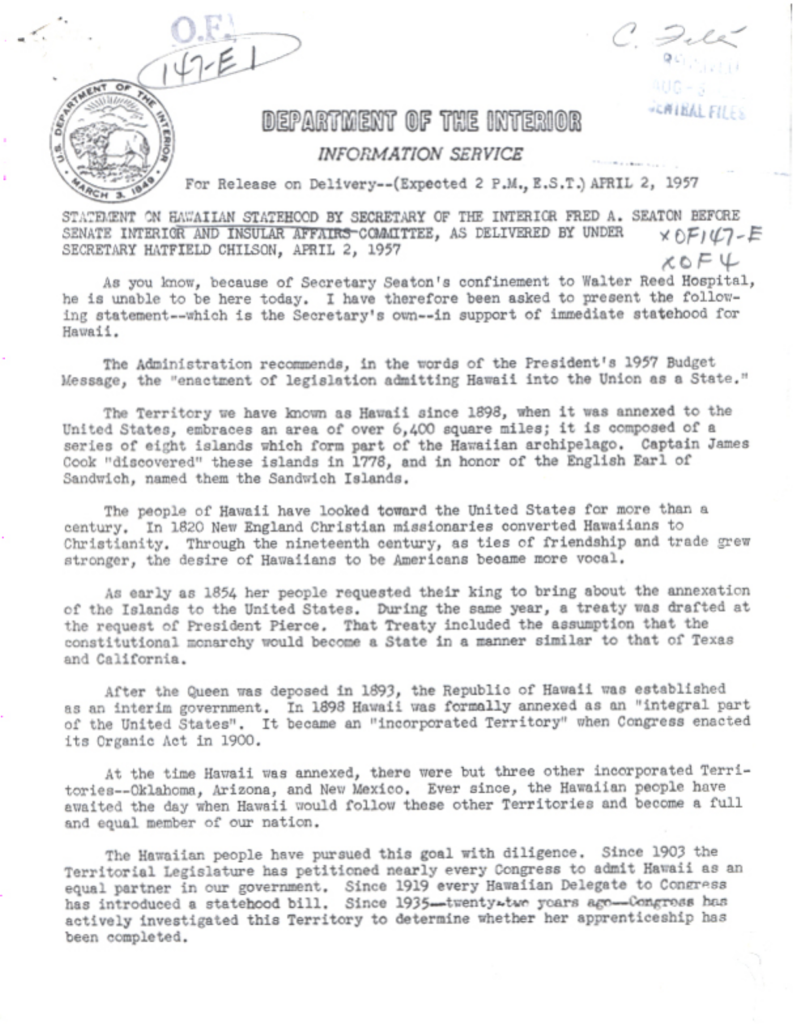
This April 2, 1957 statement by Secretary of the Interior Fred A. Seaton, delivered before the Senate Interior and Insular Affairs Committee by Under Secretary Hatfield Chilson, presents the Eisenhower administration’s case for the immediate admission of Hawaii as a state. Seaton emphasizes that President Dwight D. Eisenhower had repeatedly endorsed Hawaiian statehood and argues that decades of congressional investigations had demonstrated that Hawaii was prepared to enter the Union. He notes that both major political parties supported statehood and addresses several arguments still being raised by opponents.
Seaton rejects concerns about Hawaii’s geographic separation from the continental United States, arguing that modern air transportation had made distance increasingly irrelevant. He also confronts doubts about the loyalty of Hawaii’s diverse population and fears of Communist influence. Pointing to the service of Hawaiians during World War II and Korea, he argues that their military record demonstrated their loyalty. He similarly maintains that Hawaiians had successfully confronted Communist influence within the territory and would be even better positioned to do so as full American citizens.
The statement also emphasizes Hawaii’s ability to support itself economically. Seaton cites its sugar, pineapple, fishing, tourism, manufacturing, and other industries, along with high employment and substantial federal tax contributions. He stresses Hawaii’s strategic military importance, particularly Pearl Harbor, and argues that the territory possessed an economy comparable to those of existing states.
Most importantly, Seaton presents statehood as an issue of democratic rights and self-government. Hawaiians paid federal taxes but lacked full voting representation in Congress, could not vote for president, and remained governed in important respects by federally appointed officials. He concludes that admitting Hawaii would demonstrate America’s commitment to self-determination and equal citizenship regardless of race, color, or creed.
The document provides a valuable look at the Eisenhower administration’s arguments for Hawaiian statehood two years before Hawaii became the 50th state, showing how officials connected admission to national security, economic readiness, democratic representation, and America’s broader ideals of equal citizenship.
Used In These Lessons & Programs
Bring History to Life
Join us for engaging learning experiences designed for young minds.