
Document
Attorney General Herbert Brownell Defends the Eisenhower Administration’s Proposed Civil Rights Legislation Before Congress (1957)
Key Details
Date: February 14, 1957
Created By: Herbert Brownell
Original or Replica: Original
Era: The Presidency, Civil Rights
Collection: Eisenhower Presidential Library
Citations: E. Frederic Morrow Records, Box 9, Civil Rights Bill; NAID #12167080
About
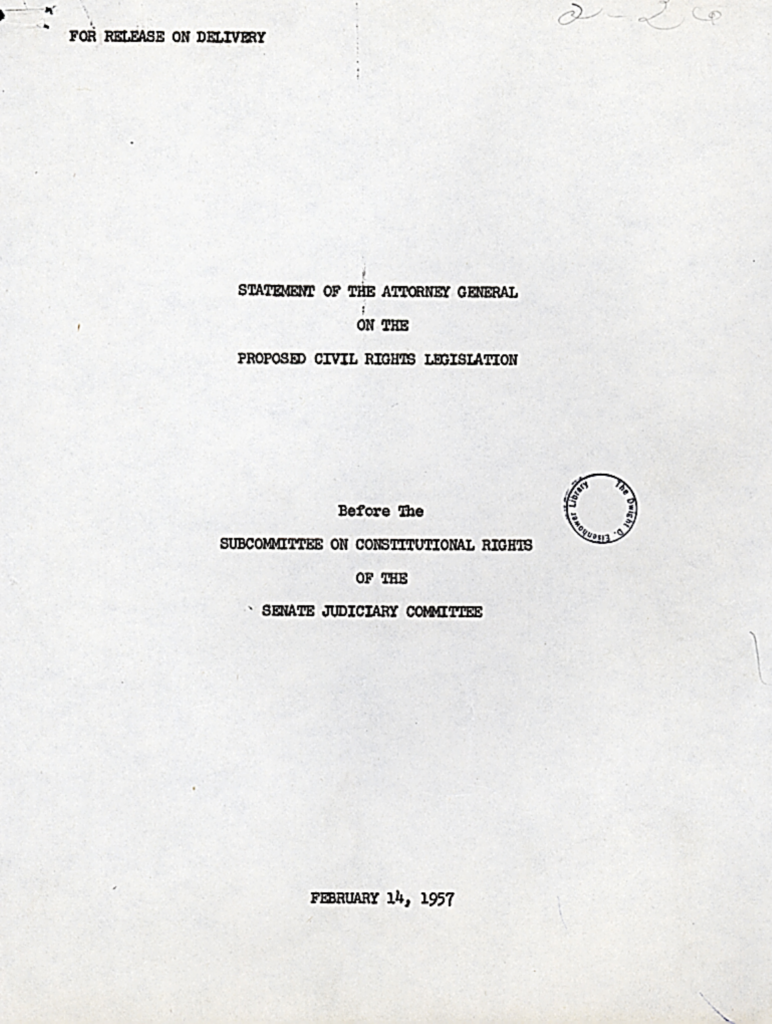
This February 14, 1957 statement by Attorney General Herbert Brownell Jr. presents the Eisenhower administration’s case for new federal civil rights legislation before the Senate Judiciary Committee’s Subcommittee on Constitutional Rights. Brownell outlines the administration’s four-part program: creating a bipartisan Civil Rights Commission, establishing a Civil Rights Division within the Department of Justice, strengthening federal authority to protect voting rights, and allowing the federal government to seek civil remedies in civil rights cases. He emphasizes President Dwight D. Eisenhower’s belief that the nation had made progress toward equal treatment but that significant work remained.
A major portion of Brownell’s testimony concerns Black voting rights. He describes examples from Louisiana and North Carolina in which discriminatory registration practices were used to prevent Black citizens from voting. Brownell argues that existing criminal prosecutions were often inadequate because they could occur only after citizens had already been denied their rights. Civil remedies, by contrast, could allow the Justice Department to intervene before an election and prevent disenfranchisement.
Brownell also discusses school desegregation following the Supreme Court’s rulings, explaining circumstances in which federal civil action could help protect school officials attempting to comply with constitutional requirements. He further defends the proposed Civil Rights Commission as a fact-finding body capable of investigating allegations of discrimination and providing Congress and the executive branch with reliable information.
The testimony provides an important explanation of the Eisenhower administration’s civil rights agenda and the reasoning behind legislation that would become the Civil Rights Act of 1957, the first federal civil rights law enacted since Reconstruction.
Used In These Lessons & Programs
Bring History to Life
Join us for engaging learning experiences designed for young minds.