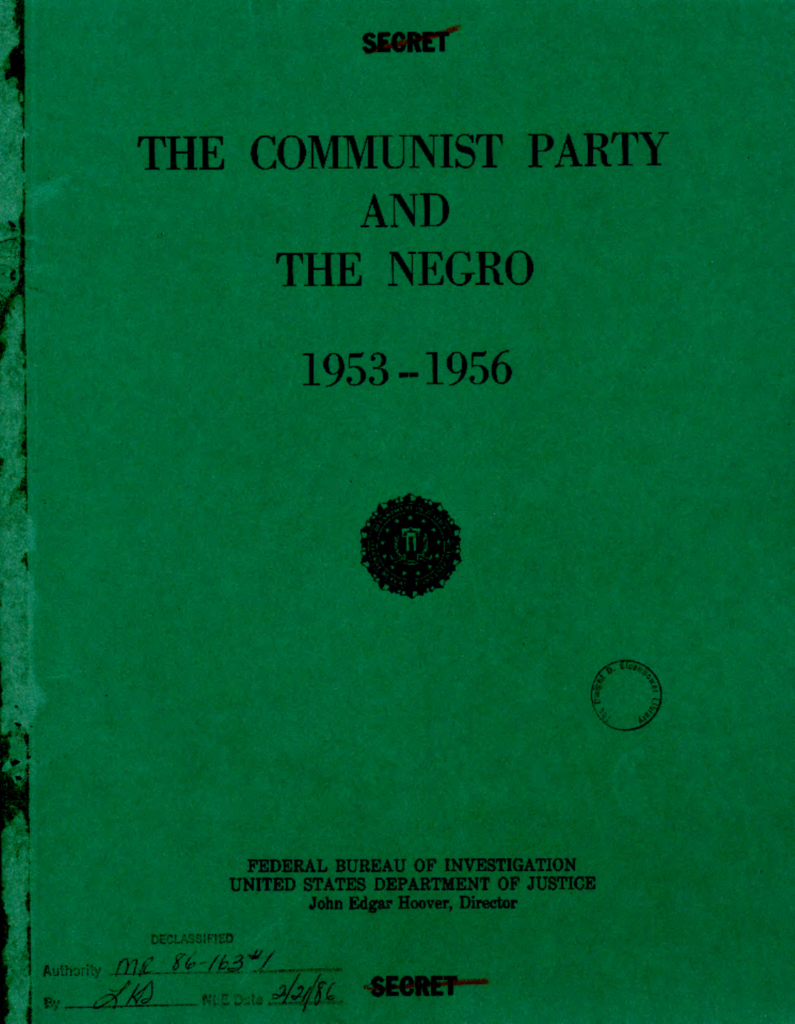
Document
FBI Study of the Communist Party’s Activities Among African Americans, 1953–1956
Key Details
Date: October 1956
Created By: Federal Bureau of Investigation
Original or Replica: Original
Era: The Presidency, Civil Rights, The Cold War
Collection: Eisenhower Presidential Library
Citations: OSANSA, FBI Series, Box 10, The Communist Party and the Negro Oct. 1956; NAID #12191457
About
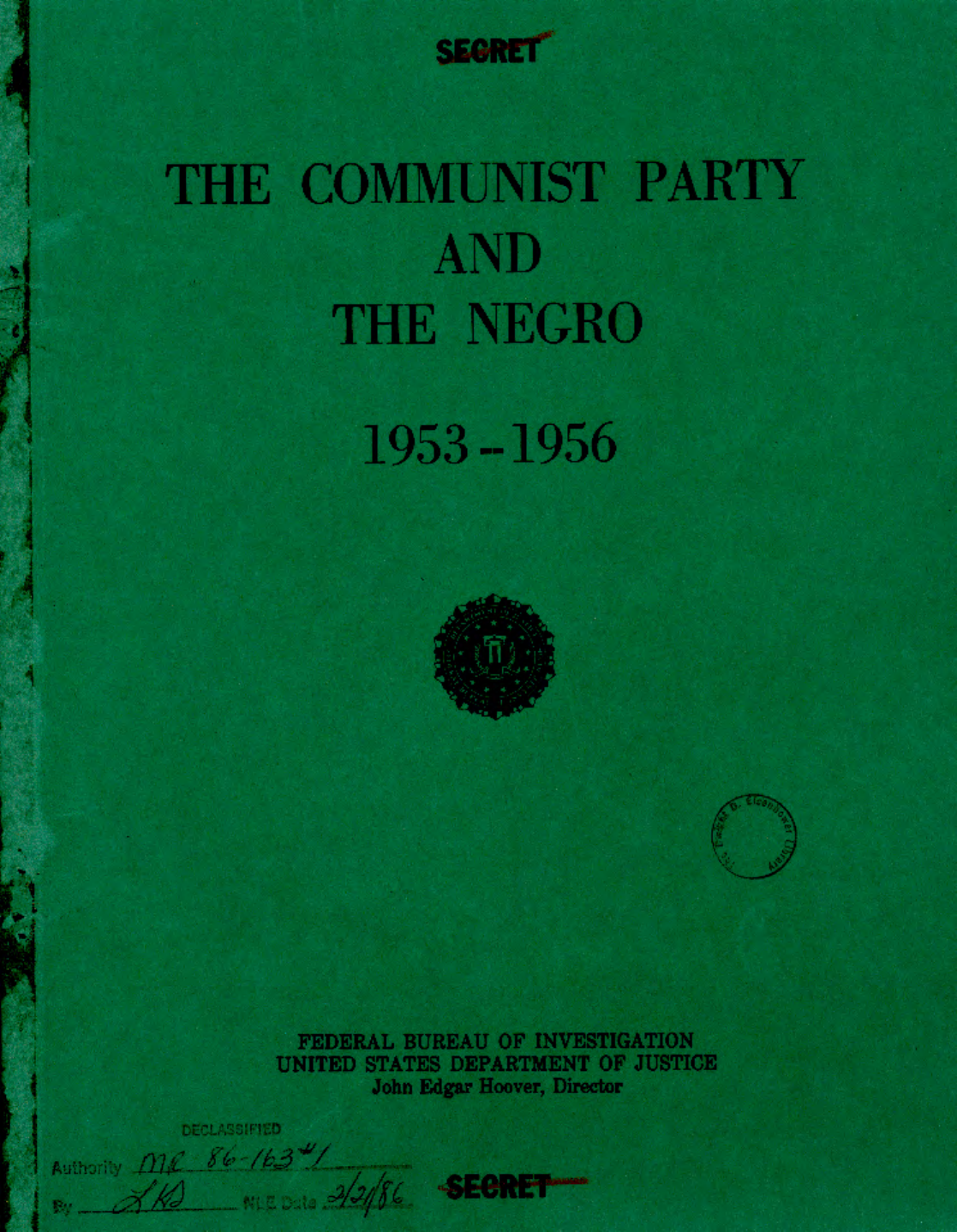
This sixty-six-page classified monograph was prepared by the Federal Bureau of Investigation under Director J. Edgar Hoover in October 1956. It examines the relationship between the Communist Party USA (CPUSA) and African Americans during the years 1953–1956 and supplements an earlier FBI study covering 1919–1952. The preface states that the report was compiled from public, confidential, and secret sources. Written from the perspective of federal domestic intelligence officials during the Cold War, the document consistently portrays Communist involvement in racial issues as an attempt to exploit legitimate grievances for revolutionary and Soviet purposes. Its claims, terminology, and judgments therefore require careful evaluation as products of the FBI’s institutional assumptions and the intense anti-communism of the 1950s.
The report surveys Communist positions on racial equality, Black political representation, employment discrimination, housing segregation, organized labor, anticolonialism, and international “peace” campaigns. It discusses the Party’s evolving support for Black “self-determination” in the Southern “Black Belt,” its interest in organizing African American industrial workers, and an alleged “colonization program” that placed Party members in Southern communities and workplaces. A substantial section analyzes Communist commentary and activity surrounding Brown v. Board of Education, Autherine Lucy’s effort to integrate the University of Alabama, the Montgomery Bus Boycott, and the murder of Emmett Till. The monograph also examines organizations the FBI regarded as Communist fronts, including the National Negro Labor Council and the National Association of Negro Trade Unionists, as well as alleged efforts to influence established organizations such as the NAACP and the Improved Benevolent Protective Order of Elks of the World.
The FBI ultimately concluded that the Communist Party had devoted considerable resources to attracting African Americans but had achieved limited success. The report estimated that Black members represented approximately seven percent of a national Party membership of slightly fewer than 20,000 in June 1956. It attributed this limited appeal to distrust of Soviet influence, opposition from established Black leaders and organizations, changes in Party policy, and racial prejudice—described in the document as “white chauvinism”—within the Party itself.
Used In These Lessons & Programs
Bring History to Life
Join us for engaging learning experiences designed for young minds.