Document
Drew Pearson Discusses the U-2 Spy Flight, Francis Gary Powers, and the Risks of Aerial Reconnaissance Over the Soviet Union (1960)
Key Details
Date: August 23, 1960
Created By: Patty Cavin conducted the interview
Original or Replica: Original
Era: The Presidency, The Cold War
Collection: Eisenhower Presidential Library
Citations: Office of the Staff Secretary, Subject Series, Alphabetical Subseries, Box 15, Intelligence Matters (17); NAID #12009418
About
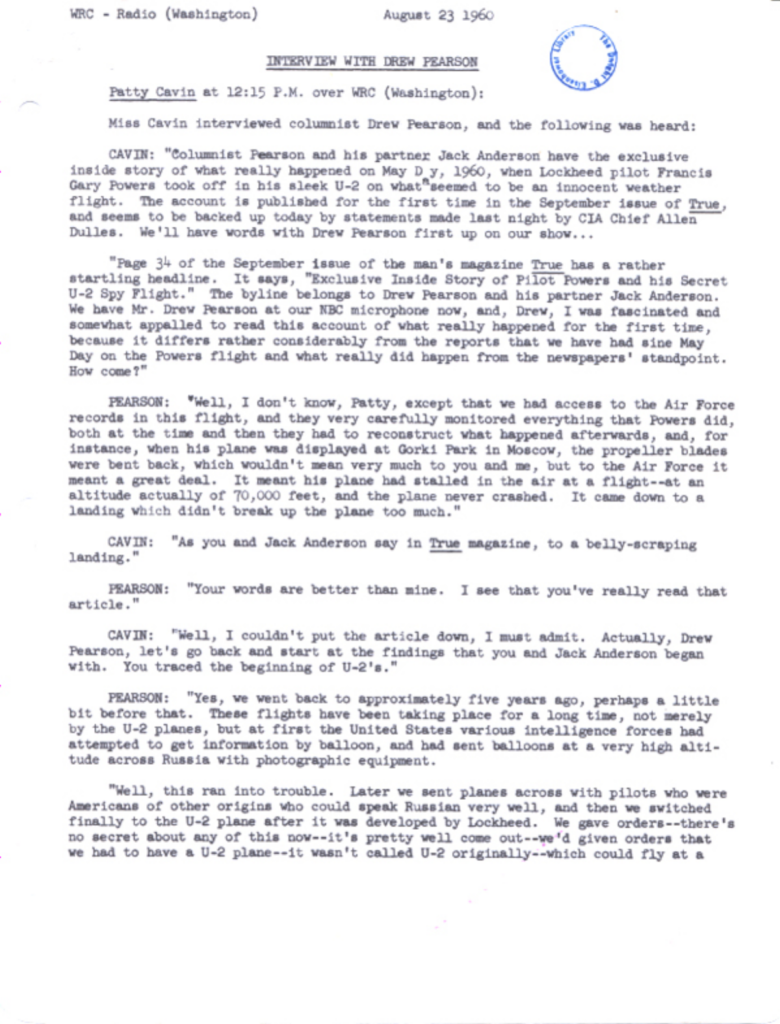
This August 23, 1960 transcript of a WRC radio interview records journalist Patty Cavin’s conversation with syndicated columnist Drew Pearson about the May 1, 1960 U-2 incident and captured American pilot Francis Gary Powers. Pearson discusses an article he coauthored with Jack Anderson that claimed to provide new details about Powers’s final reconnaissance mission. Drawing on what Pearson describes as access to Air Force records, he disputes portions of Powers’s Soviet trial testimony, particularly Powers’s claim that his aircraft had been struck by Soviet fire at approximately 68,000 feet. Pearson instead argues that the U-2’s engine stalled near 70,000 feet and that Powers descended to restart it before being shot down.
The interview also explores the larger history and purpose of American reconnaissance over the Soviet Union. Pearson describes earlier intelligence-gathering efforts involving balloons and aircraft before the introduction of the U-2. He emphasizes the importance of aerial photography for locating Soviet military installations, missile bases, and other strategic targets that could not easily be observed by other means. Pearson further claims that Soviet officials had become aware of previous U-2 flights and were anticipating another mission when Powers entered Soviet airspace on May 1.
Pearson and Cavin also discuss Powers’s capture, including reports that he carried a poisoned needle for use if captured. Pearson argues that Powers had been instructed to tell the truth if captured and rejects speculation that he had deliberately betrayed the United States, describing him instead as an ordinary man who chose to survive. The interview concludes by looking toward satellite reconnaissance as a possible replacement for dangerous manned overflights.
The document provides a valuable example of how the American press interpreted and debated the U-2 Incident only months after it occurred, particularly the controversy surrounding Powers’s actions and the growing recognition that reconnaissance satellites could eventually replace risky flights over Soviet territory.
Document(s)
Used In These Lessons & Programs
Bring History to Life
Join us for engaging learning experiences designed for young minds.