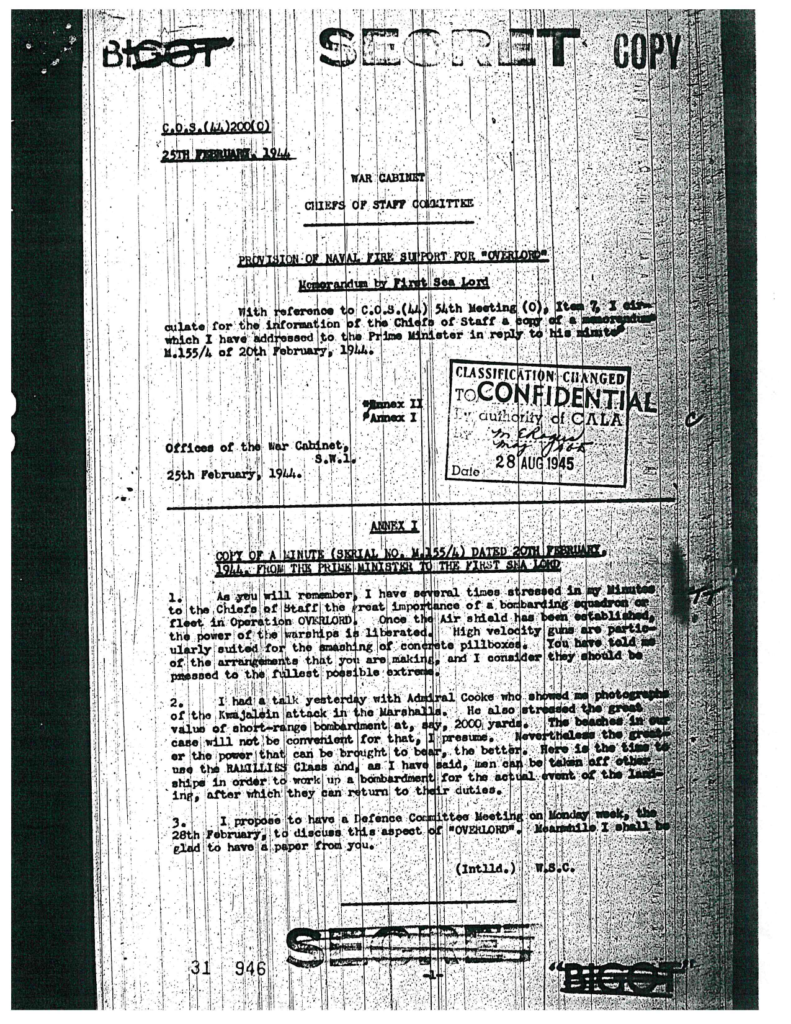
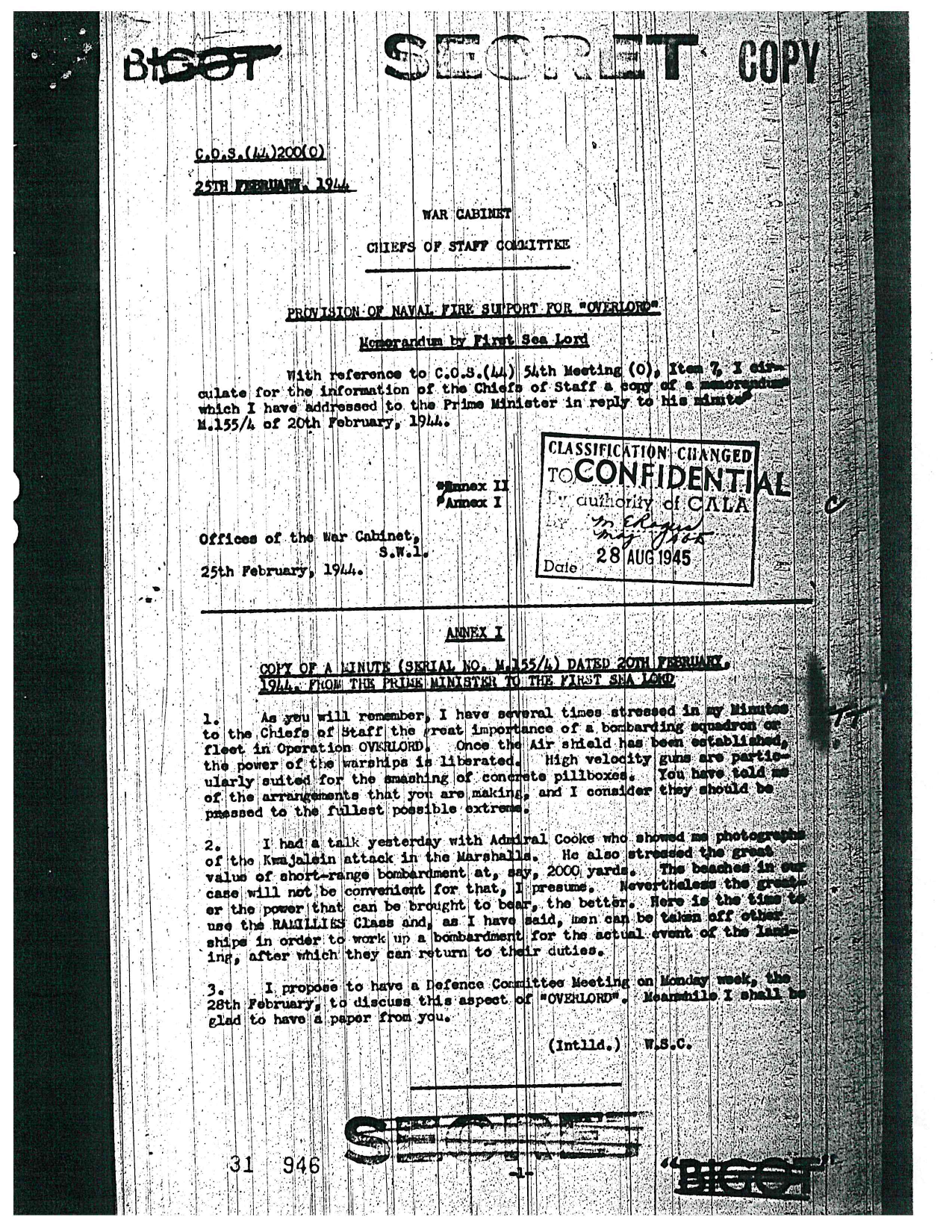
Document
British Military Leaders Assess Naval Gunfire Support Requirements for Operation Overlord (1944)
Key Details
Date: February 25, 1944
Created By: Office of the War Cabinet
Original or Replica: Original
Era: The General, D-Day and the Normandy Invasion
Collection: Eisenhower Presidential Library
Citations: Eisenhower Presidential Library and Museum
About
This February 25, 1944 British War Cabinet and Chiefs of Staff document examines the naval gunfire support required for Operation Overlord, the planned Allied invasion of Normandy. Prepared as invasion planning intensified, the report evaluates how battleships, monitors, destroyers, landing craft, aircraft, and other resources could support troops during the assault. The planners divide naval fire support into three principal missions: neutralizing German coastal defenses capable of attacking the invasion force, providing close fire support against defenses on and immediately behind the beaches, and bombarding targets farther inland to disrupt German troop concentrations and reinforcements.
The report emphasizes the difficulty of destroying heavily fortified German positions with naval gunfire alone. Large-caliber guns could be valuable against coastal batteries, but their effectiveness depended upon accurate spotting, suitable ammunition, and the availability of ships. For defenses closer to the landing beaches, planners envisioned combining naval bombardment with air attacks and specialized close-support landing craft. Particular attention is given to the critical period immediately before troops reached shore, when naval and aerial fire would need to suppress German defenses until the assault forces could establish themselves.
The document also weighs the limited number of battleships and other vessels available against the many competing fire-support requirements. It provides a detailed look at the technical and logistical planning behind the D-Day landings and demonstrates the extensive coordination required among Allied naval, air, and ground forces before the invasion of Normandy.
Used In These Lessons & Programs
Bring History to Life
Join us for engaging learning experiences designed for young minds.