Document
Eisenhower Signs the Federal-Aid Highway Act of 1958 While Warning Against Changes to Highway Funding (1958)
Key Details
Date: April 16, 1958
Created By: Dwight D. Eisenhower and James Hagerty
Original or Replica: Original
Era: The Presidency, The Interstate Highway System
Collection: Eisenhower Presidential Library
Citations: DDE’s Records as President, Official File, Box 612, OF 141-B Highways and Thoroughfares (19); NAID #16857674
About
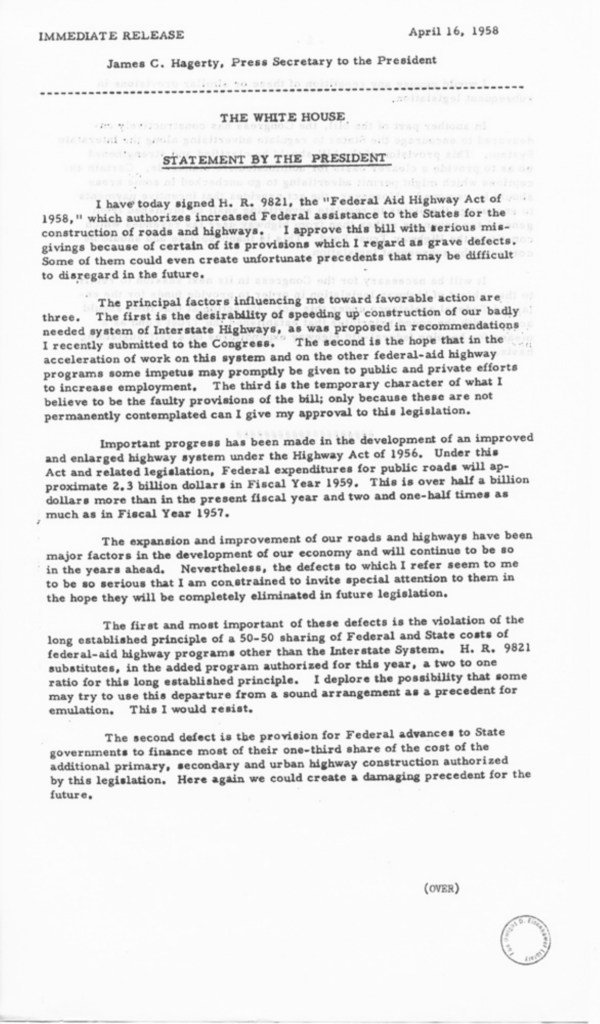
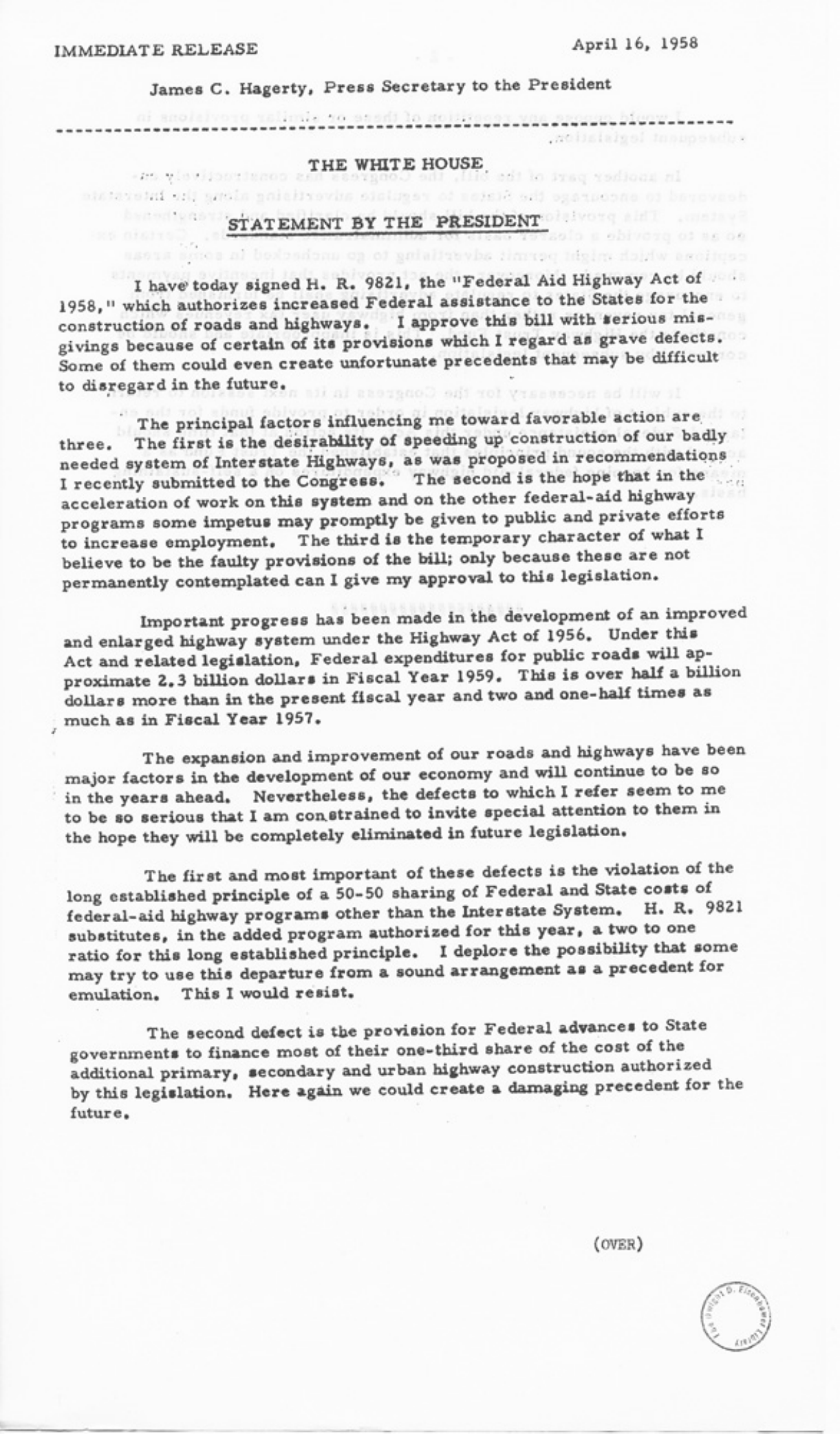
This April 16, 1958 White House statement explains President Dwight D. Eisenhower’s decision to sign the Federal-Aid Highway Act of 1958 despite serious objections to several of its provisions. Eisenhower states that he approved the legislation primarily because it would accelerate construction of the Interstate Highway System, encourage additional highway construction during an economic downturn, and potentially increase employment. He also emphasizes that several provisions he disliked were temporary and could therefore be corrected through future legislation.
The legislation significantly increased federal highway spending. Eisenhower notes that approximately $2.3 billion in federal funds would be spent on public roads during fiscal year 1959, more than half a billion dollars above the current fiscal year and roughly two-and-a-half times the amount spent in fiscal year 1957. Although he regarded highway construction as important to continued economic development, he warned that Congress had included provisions that threatened established principles governing the federal highway program.
Eisenhower’s strongest objection concerned temporarily changing the traditional 50–50 division of federal and state costs for federal-aid highways outside the Interstate System to a two-to-one federal contribution. He feared this could establish a precedent for greater federal responsibility. He similarly objected to federal advances allowing states to finance much of their required share of additional highway construction.
The president also supported stronger state regulation of advertising along Interstate highways, but objected to funding incentives coming from general federal revenues rather than highway-user taxes. He concludes by calling on Congress to restore highway financing to the self-sustaining Highway Trust Fund principle in future legislation.
The document provides a valuable look at Eisenhower’s philosophy toward the Interstate Highway System, showing that while he strongly supported rapid highway construction, he remained concerned about federal spending, state responsibility, and maintaining the original financing structure of the national highway program.
Document(s)
Used In These Lessons & Programs
Bring History to Life
Join us for engaging learning experiences designed for young minds.