
Document
Eisenhower Denies Executive Clemency to Julius and Ethel Rosenberg (1953)
Key Details
Date: February 11, 1953
Created By: James C. Hagerty
Original or Replica: Original
Era: The Presidency, The Rosenberg Case
Collection: Eisenhower Presidential Library
Citations: NSC Staff Papers, PSB Central Files Series, Box 26, PSB 383.4; NAID #12572005
About
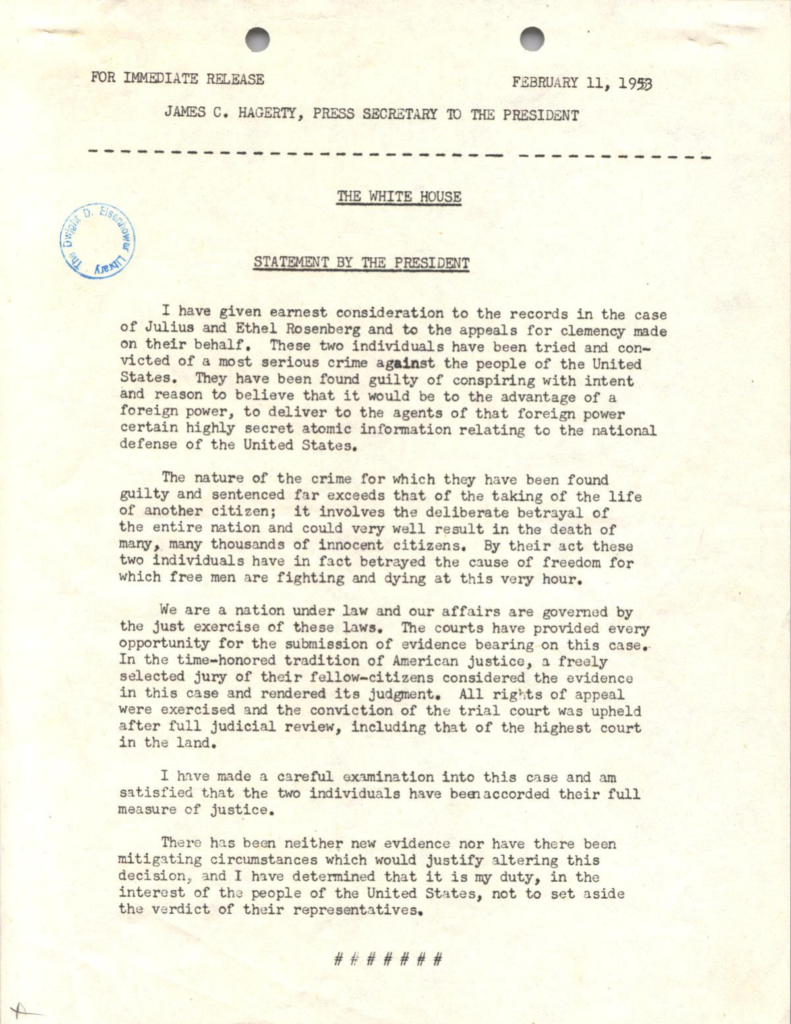
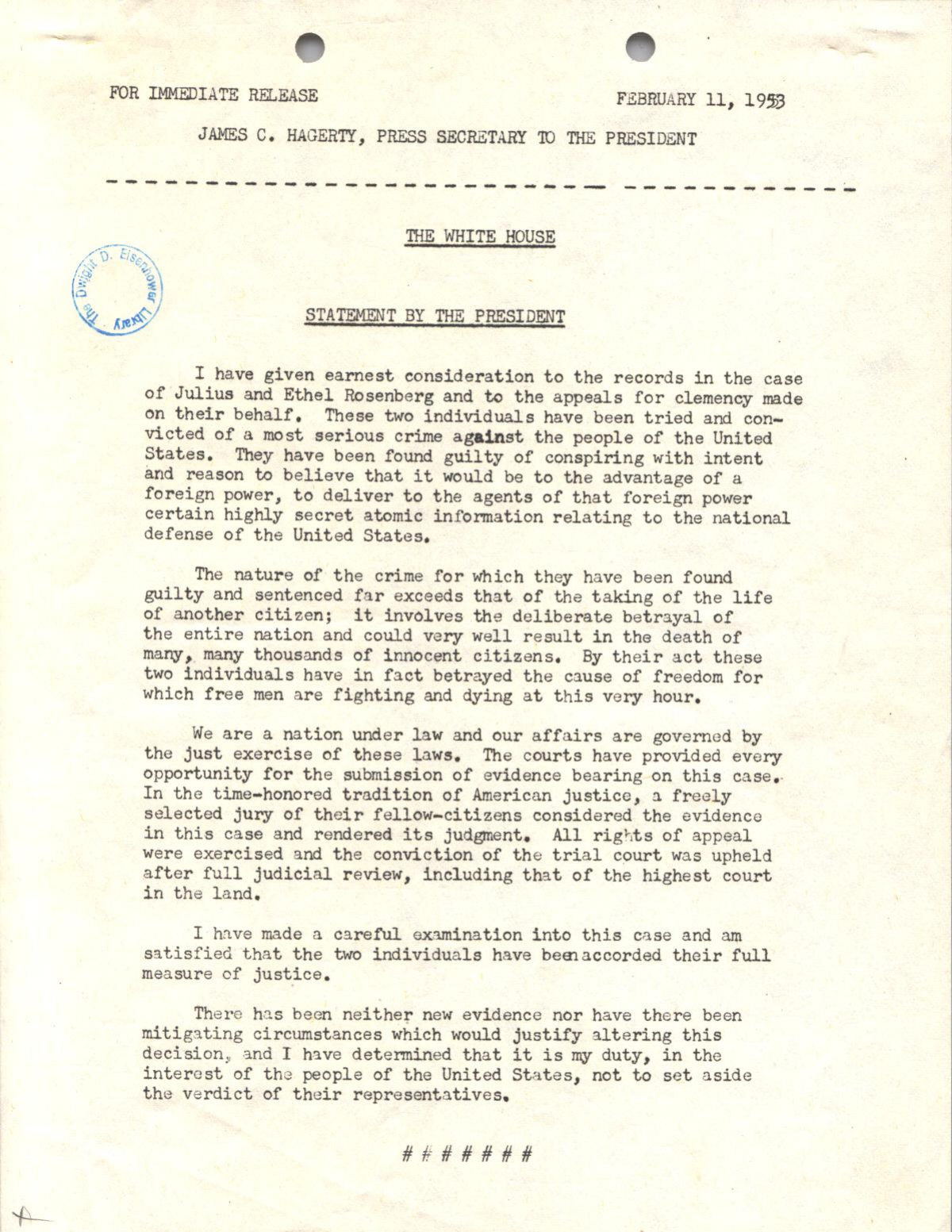
In this February 11, 1953 statement, President Dwight D. Eisenhower announces his decision to deny executive clemency to Julius and Ethel Rosenberg, who had been convicted of conspiracy to commit espionage and sentenced to death. Eisenhower states that he carefully reviewed the case and the appeals submitted on the Rosenbergs’ behalf. He describes their crime as exceptionally serious, emphasizing that they had been convicted of conspiring to provide a foreign power with highly secret atomic information related to the national defense of the United States.
Eisenhower argues that the consequences of their actions extended far beyond the betrayal of a single individual. He characterizes their espionage as a betrayal of the nation that could contribute to the deaths of thousands of innocent people and declares that the Rosenbergs had betrayed the cause of freedom for which Americans were then fighting and dying. He also emphasizes the extensive judicial process afforded to them, noting that a jury had convicted the Rosenbergs and that their convictions had survived appeals through the nation’s highest court.
Eisenhower concludes that his own examination revealed no new evidence or mitigating circumstances sufficient to justify changing their sentences. Presenting the issue as one of both presidential responsibility and respect for the rule of law, he states that it was his duty not to overturn the judgment reached through the American judicial system. The statement documents Eisenhower’s formal reasoning for one of the most controversial clemency decisions of his presidency.
Document(s)
Used In These Lessons & Programs
Bring History to Life
Join us for engaging learning experiences designed for young minds.