Document
Eisenhower Proposes Atoms for Peace Before the United Nations General Assembly (1953)
Key Details
Date: December 8, 1953
Created By: James C. Hagerty
Original or Replica: Original
Era: The Presidency, The Cold War
Collection: Eisenhower Presidential Library
Citations: DDE’s Papers as President, Speech Series, Box 5, United Nations Speech 12/8/53
About
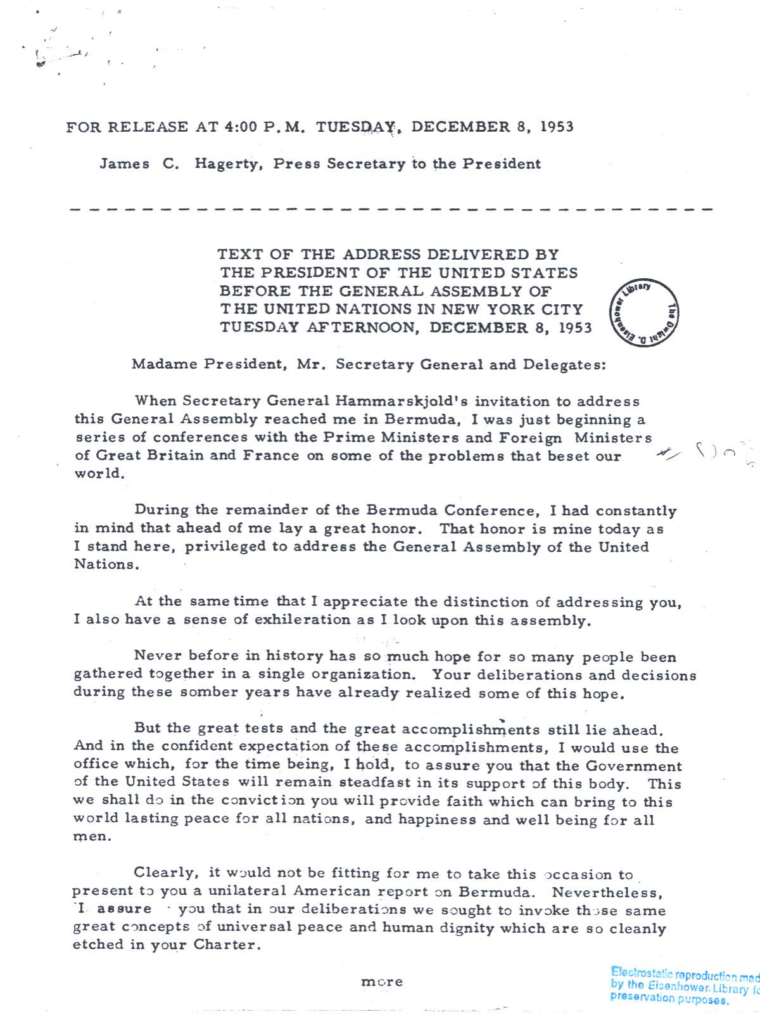
In this December 8, 1953 address before the United Nations General Assembly, President Dwight D. Eisenhower confronts the growing danger of nuclear warfare and introduces the proposal that became known as Atoms for Peace. Eisenhower explains the rapid development of atomic weapons since 1945 and warns that the United States no longer possesses a monopoly on nuclear technology. With the Soviet Union developing its own atomic and thermonuclear weapons, he argues that continued competition could produce devastating consequences for civilization. Military strength and deterrence remained necessary, but Eisenhower insists that accumulating increasingly destructive weapons could not by itself provide lasting security.
Eisenhower therefore proposes redirecting part of the world’s nuclear resources toward peaceful purposes. The United States and other nations possessing nuclear materials would contribute uranium and other fissionable materials to an international atomic energy agency operating under the United Nations. Rather than being used for weapons, these materials could support agriculture, medicine, scientific research, and the production of electrical power, particularly in areas suffering from energy shortages.
The proposal was intended not only to expand the peaceful uses of atomic energy but also to reduce nuclear stockpiles and create a new avenue for negotiations between the United States, Soviet Union, and other powers. Eisenhower concludes by presenting the initiative as an effort to transform humanity’s scientific ingenuity from a source of destruction into an instrument for improving human life. The speech became one of the defining statements of Eisenhower’s Cold War nuclear policy and international diplomacy.
Used In These Lessons & Programs
Bring History to Life
Join us for engaging learning experiences designed for young minds.