Document
White House Advisers Recommend That Eisenhower Publicly Confront Senator Joseph McCarthy (1953)
Key Details
Date: December 1, 1953
Created By: Stanley M. Rumbough Jr. and Charles Masterson
Original or Replica: Original
Era: The Presidency, McCarthyism and the Red Scare
Collection: Eisenhower Presidential Library
Citations: DDE’s Records as President, Official File, Box 317, OF99-R McCarthy, Hon. Joseph R.; NAID #16702981
About
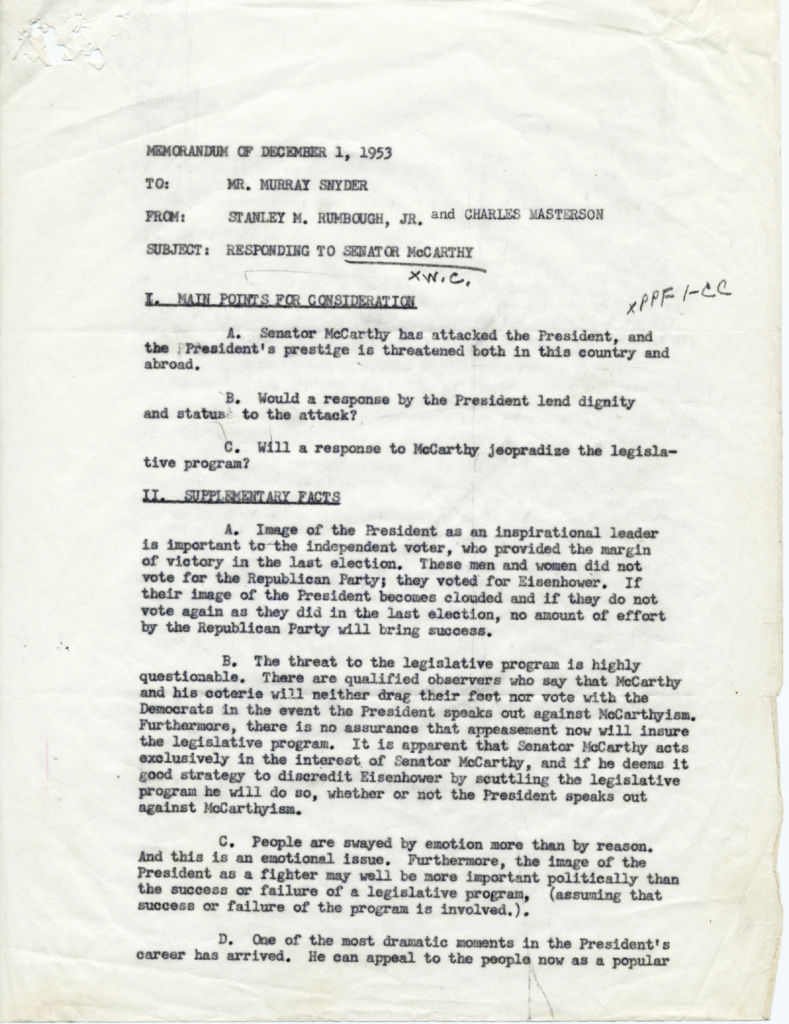
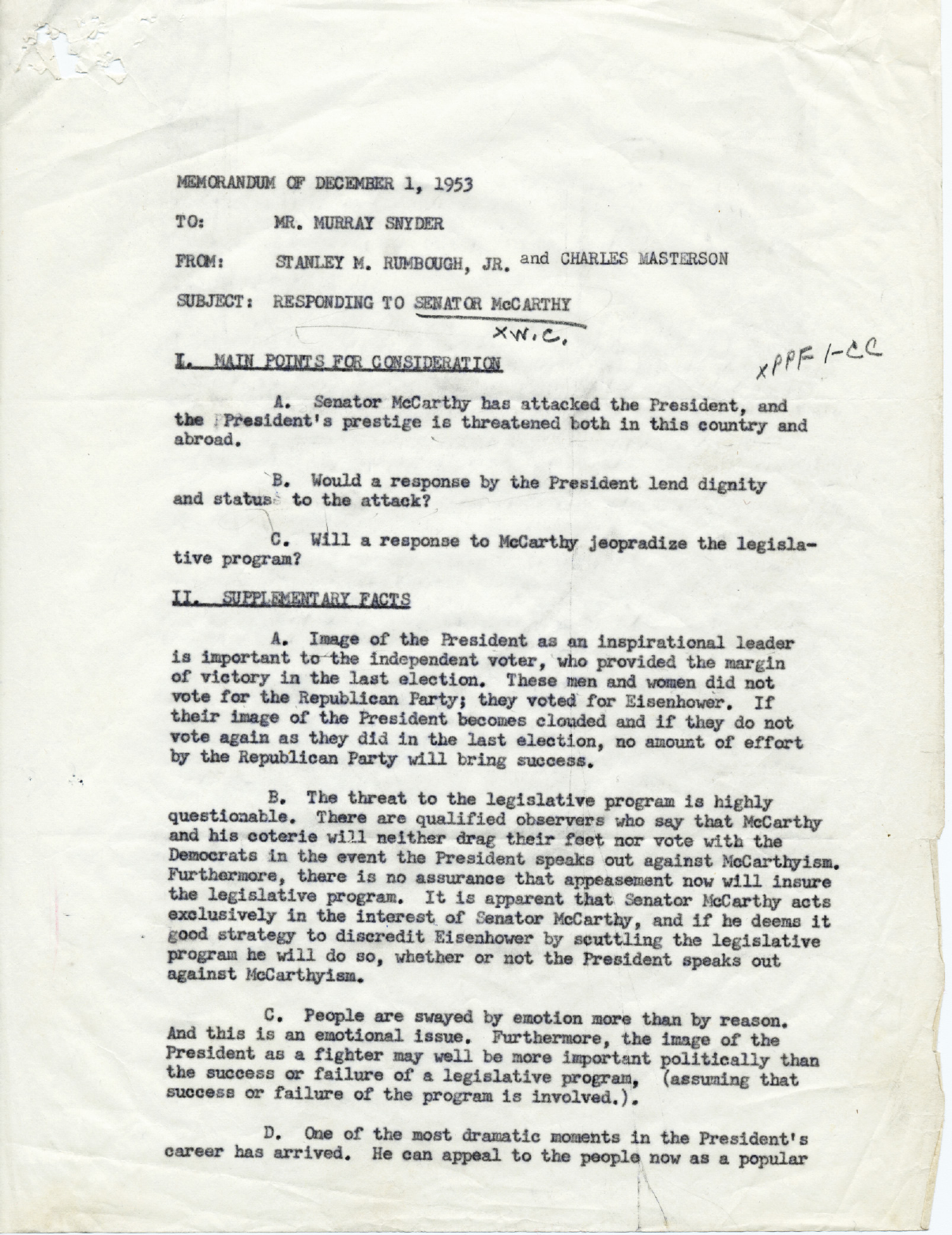
In this December 1, 1953 memorandum to White House press official Murray Snyder, presidential aides Stanley M. Rumbough Jr. and Charles Masterson consider how President Dwight D. Eisenhower should respond to attacks by Senator Joseph McCarthy. The authors believe McCarthy’s attacks threatened Eisenhower’s prestige both at home and abroad, but they weigh whether a presidential response might give McCarthy additional attention or jeopardize the administration’s legislative agenda. They argue that Eisenhower’s personal reputation was particularly important among independent voters who had supported him in 1952 even though they did not normally vote Republican.
The memorandum questions the argument that confronting McCarthy would necessarily damage Eisenhower’s legislative program. The authors suggest McCarthy was already attempting to discredit the president and contend that Eisenhower’s image as a leader willing to fight for American principles might ultimately be more politically important than individual legislative victories. They portray opposition to McCarthyism as consistent with American traditions of fair play, the Bill of Rights, and the principles associated with Washington and Lincoln.
The advisers recommend that Eisenhower use a televised press conference to respond publicly and that Secretary of State John Foster Dulles answer specific McCarthy accusations concerning issues such as trade with Communist countries and American prisoners in Korea. They also provide suggested language emphasizing that the administration remained determined to combat genuine Communist influence while refusing to allow political motives, fanaticism, or reckless accusations to undermine traditional American values.
The memorandum provides a revealing look at the Eisenhower administration’s internal debate over whether the president should directly confront McCarthy and how to distinguish legitimate anti-Communism from McCarthyism.
Used In These Lessons & Programs
Bring History to Life
Join us for engaging learning experiences designed for young minds.