Document
Psychological Strategy Board Considers Using a Prisoner Exchange Proposal to Undermine Soviet Propaganda (1953)
Key Details
Date: March 3, 1953
Original or Replica: Original
Era: The Presidency, The Rosenberg Case, The Cold War
Collection: Eisenhower Presidential Library
Citations: NSC Staff Papers, PSB Central Files Series, Box 26, PSB 383.4; NAID #12572006
About
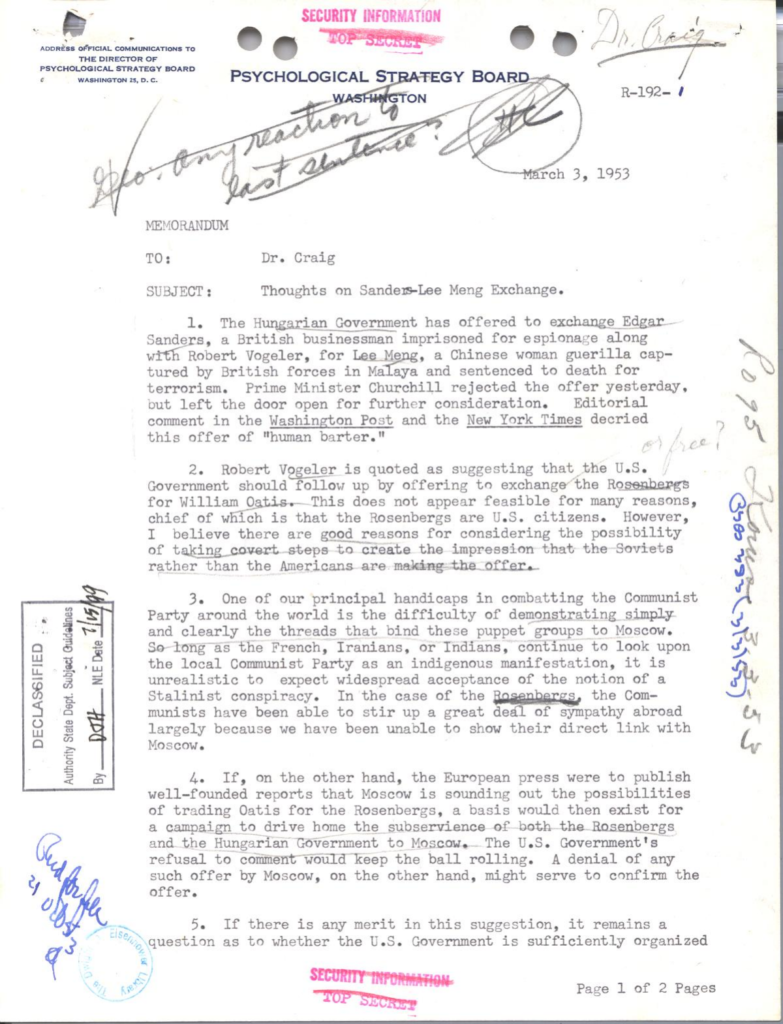
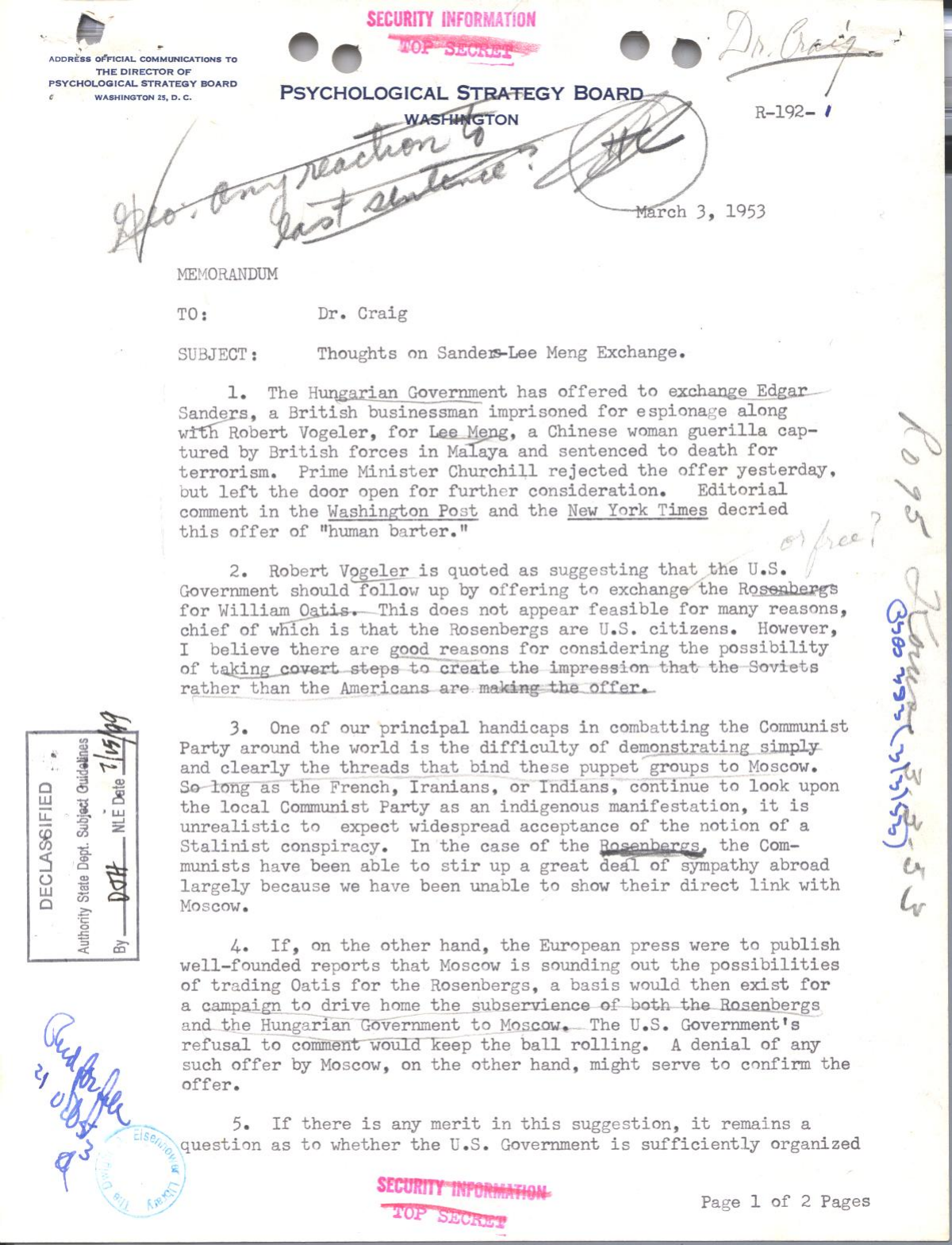
This March 3, 1953 memorandum from W. A. Korns of the Psychological Strategy Board examines whether a proposed prisoner exchange could be used as part of America’s Cold War psychological strategy. The discussion followed Hungary’s offer to exchange imprisoned British businessman Edgar Sanders and American Robert Vogeler for Lee Meng, a Chinese woman guerrilla captured by British forces in Malaya. Although British Prime Minister Winston Churchill rejected the proposal, the incident prompted consideration of other possible exchanges.
Korns discusses a suggestion that the United States offer to exchange Julius and Ethel Rosenberg, who had been convicted of espionage, for American journalist William Oatis, then imprisoned by Communist Czechoslovakia. He acknowledges serious obstacles, including the Rosenbergs’ American citizenship, but argues that even proposing an exchange might serve propaganda purposes. If Moscow accepted, American officials could portray this as evidence connecting the Rosenbergs directly to the Soviet Union; if Moscow rejected it, the refusal might still strengthen the American position. Korns concludes by questioning whether the U.S. government was organized to conduct such unconventional psychological operations. The memorandum illustrates how American officials considered propaganda and public opinion as tools for challenging Soviet influence during the early Cold War.
Used In These Lessons & Programs
Bring History to Life
Join us for engaging learning experiences designed for young minds.