Document
E. Frederic Morrow Urges the Eisenhower Administration to Address Racial Violence and Strengthen Its Civil Rights Leadership (1955)
Key Details
Date: December 16, 1955
Created By: E. Frederic Morrow
Original or Replica: Original
Era: The Presidency, Civil Rights
Collection: Eisenhower Presidential Library
Citations: E. Frederic Morrow Records, Box 10, Civil Rights Official Memoranda 1956-1955; NAID #12191320
About
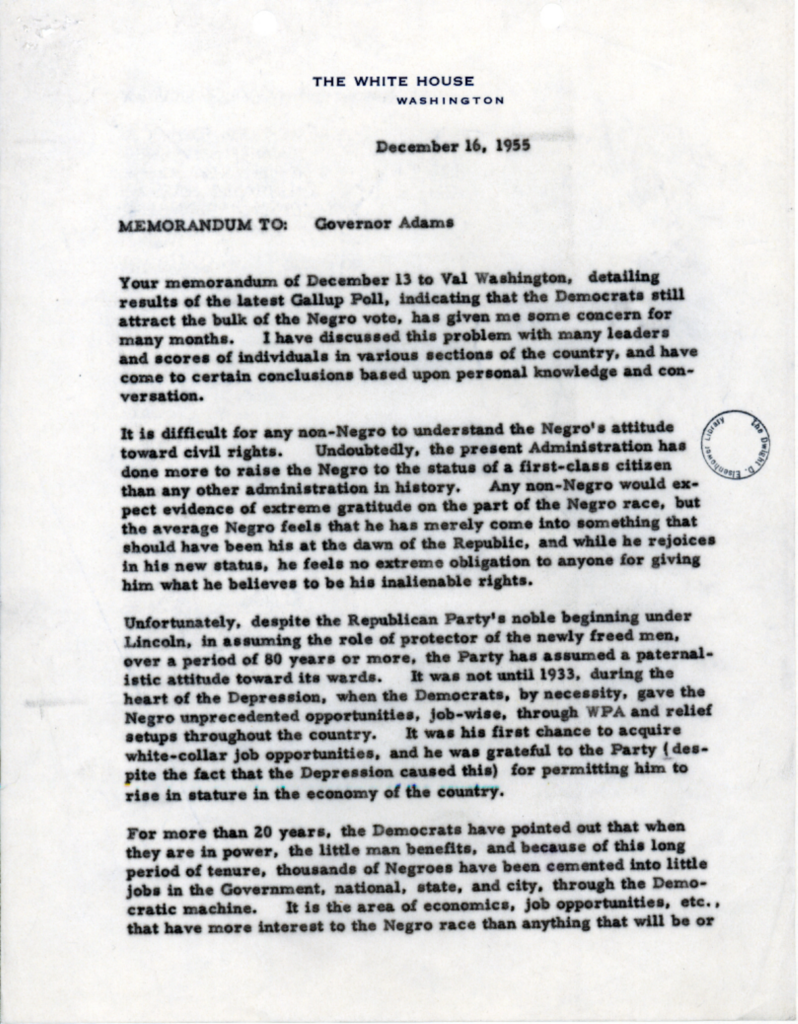
In this December 16, 1955 memorandum to White House Chief of Staff Sherman Adams, presidential aide E. Frederic Morrow assesses the Eisenhower administration’s relationship with Black Americans and recommends steps to strengthen its leadership on civil rights. Responding partly to polling showing that Democrats continued to receive the majority of the Black vote, Morrow argues that although the Eisenhower administration had accomplished more for Black Americans than previous administrations, many Black voters regarded civil rights as something they were inherently entitled to rather than something for which they should feel politically grateful. He also emphasizes the importance of economic opportunity and explains why Black voters had become strongly aligned with the Democratic Party since the New Deal.
Morrow expresses particular concern about conditions in Mississippi, where violence, intimidation, and economic retaliation against Black citizens had created fear throughout Black communities. He criticizes the administration for failing to speak forcefully enough against these conditions and warns that Black leaders increasingly believed the federal government had abandoned African Americans in the South. He also argues that the administration had done a poor job publicizing its civil rights accomplishments and lacked enough Black officials able to communicate those achievements publicly.
Morrow recommends that the administration publicly condemn lawlessness in Mississippi, appoint more Black Americans to positions of responsibility, include prominent Black leaders in Republican events, more openly emphasize the administration’s civil rights record, and convene leading Black and white ministers to discuss racial violence and possible solutions.
The memorandum provides a revealing internal critique of the Eisenhower administration’s civil rights strategy and its response to racial violence during the early Civil Rights Movement.
Used In These Lessons & Programs
Bring History to Life
Join us for engaging learning experiences designed for young minds.