
Science Adviser James Killian Assesses U.S. Missile Development and Satellite Programs After Sputnik (1957)
Key Details
Date: December 28, 1957
Created By: Dr. J.R. Killian
Original or Replica: Original
Era: The Space Race, The Presidency
Collection: Eisenhower Presidential Library
Citations: DDE’s Papers as President, Administration Series, Box 23, James R. Killian 1957 (2); NAID #12042591
About
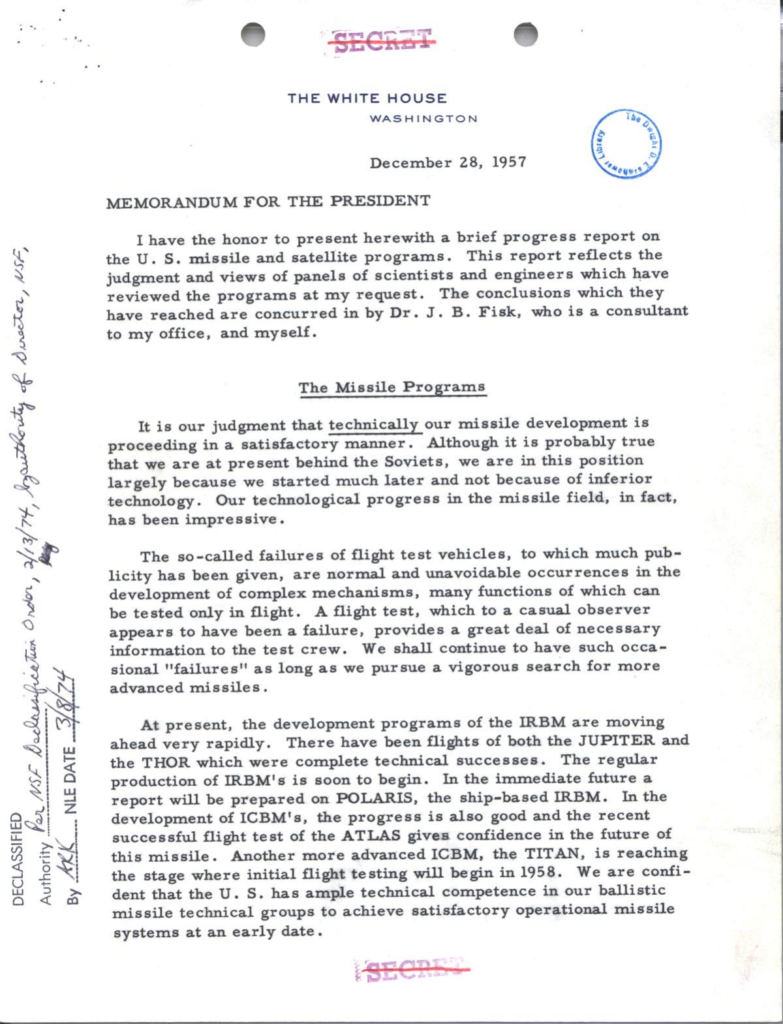
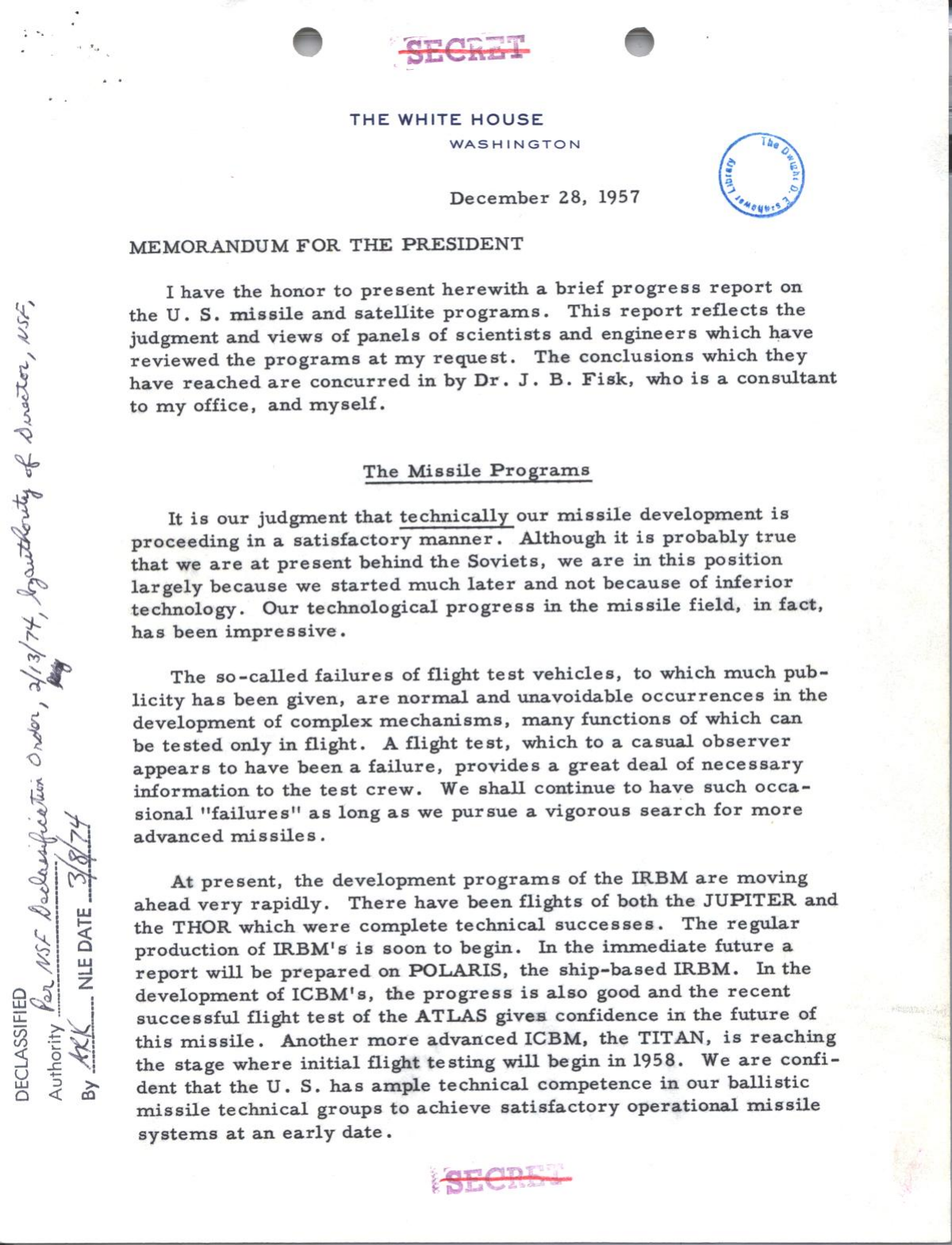
In this December 28, 1957 memorandum to President Dwight D. Eisenhower, presidential science adviser James R. Killian Jr. provides a progress report on American missile and satellite programs following the Soviet Union’s Sputnik launches. Killian acknowledges that the United States was currently behind the Soviet Union in missile development, but argues that this resulted largely from the Soviets beginning earlier rather than from inferior American technology. He describes U.S. missile development as technically satisfactory and cautions that highly publicized test failures were a normal and necessary part of developing increasingly complex weapons.
Killian reports encouraging progress with several missile systems. The Jupiter and Thor intermediate-range ballistic missiles had completed successful flights, while development of the Polaris submarine-launched missile and Atlas intercontinental ballistic missile was progressing well. He also emphasizes the need for continued research into more advanced missile technologies rather than concentrating exclusively on systems already under development.
The memorandum also evaluates America’s competing satellite programs following the highly publicized failure of a Vanguard launch earlier that month. Killian’s scientific panel concludes that Vanguard faced significant technical difficulties and recommends against expanding it. Instead, additional resources should support the Army’s Jupiter-C satellite program, which the panel believed had a substantially greater probability of successfully placing an American satellite into orbit. Killian also recommends avoiding excessive advance publicity for future launches because of the uncertainty inherent in experimental testing.
The document provides an important look at the Eisenhower administration’s assessment of American missile and satellite capabilities during the immediate response to Sputnik and its efforts to accelerate the U.S. space program.
Used In These Lessons & Programs
Bring History to Life
Join us for engaging learning experiences designed for young minds.