
Document
Project Candor Adviser Proposes Using Soviet Hydrogen Bomb Claims to Highlight American Scientific and Industrial Strength (1953)
Key Details
Date: August 10, 1953
Created By: Charles Norberg
Original or Replica: Original
Era: The Presidency, The Cold War
Collection: Eisenhower Presidential Library
Citations: White House Office, National Security Council Staff Papers, PSB Central Files Series, Box 17, PSB 091.4 U.S. (2); NAID #12021614
About
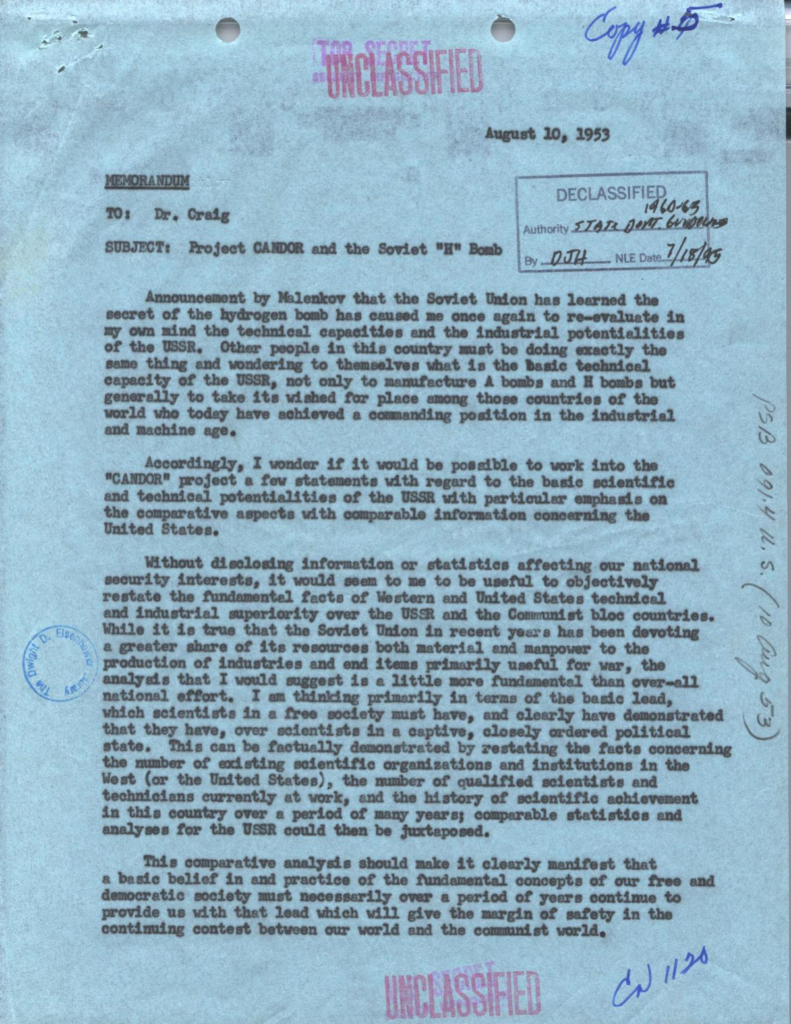
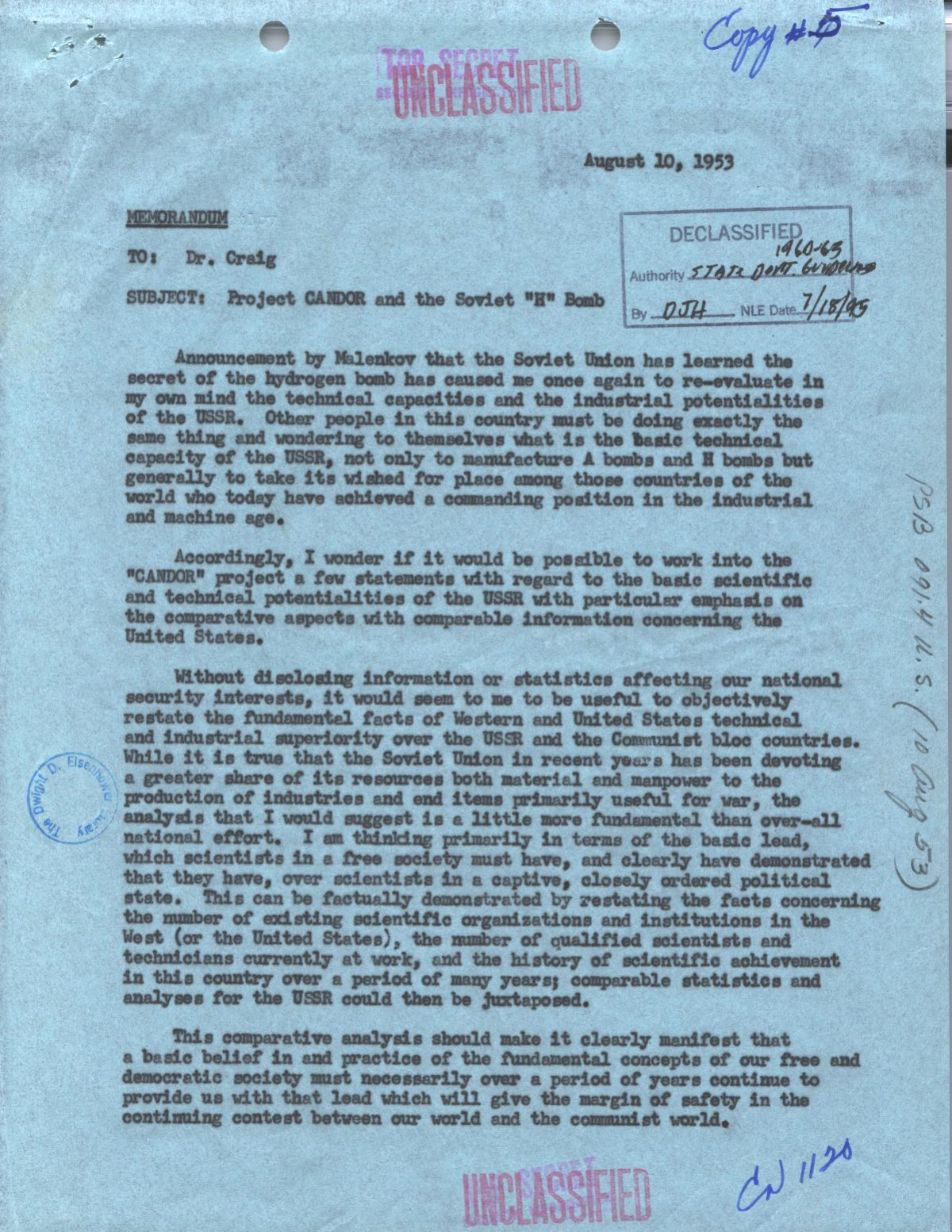
In this August 10, 1953 memorandum concerning Project Candor and the Soviet hydrogen bomb, Charles R. Norberg responds to Soviet Premier Georgy Malenkov’s announcement that the Soviet Union possessed the secret of the hydrogen bomb. Norberg argues that the announcement would naturally cause Americans and people abroad to reconsider their assumptions about Soviet scientific and industrial capabilities. He therefore suggests incorporating the issue into Project Candor, the Eisenhower administration’s effort to inform the public about the realities of the nuclear age.
Rather than focusing narrowly on nuclear weapons, Norberg recommends comparing the broader scientific, technological, and industrial capabilities of the United States and Soviet Union. Without revealing classified information, he believes the administration could demonstrate that the Western democracies retained fundamental advantages over the Communist bloc. Although the Soviet Union had devoted enormous resources and manpower to industries directly supporting military power, Norberg argues that American strength rested on a broader foundation of scientific achievement, industrial capacity, and technological development.
Norberg places particular emphasis on the advantages of a free society. He suggests comparing the number of scientific institutions, qualified scientists and technicians, and significant scientific accomplishments in the United States and the Soviet Union. Such an analysis, he argues, could demonstrate that scientists operating freely possessed an advantage over those working within a tightly controlled political system. He nevertheless cautions against complacency, stressing that the United States would need to maintain its commitment to democratic principles and scientific progress to preserve its advantage.
The document provides a valuable look at how the Eisenhower administration considered responding publicly to Soviet nuclear advances, revealing the close relationship between nuclear weapons, scientific competition, public information, and ideological rivalry during the early Cold War.
Document(s)
Used In These Lessons & Programs
Bring History to Life
Join us for engaging learning experiences designed for young minds.