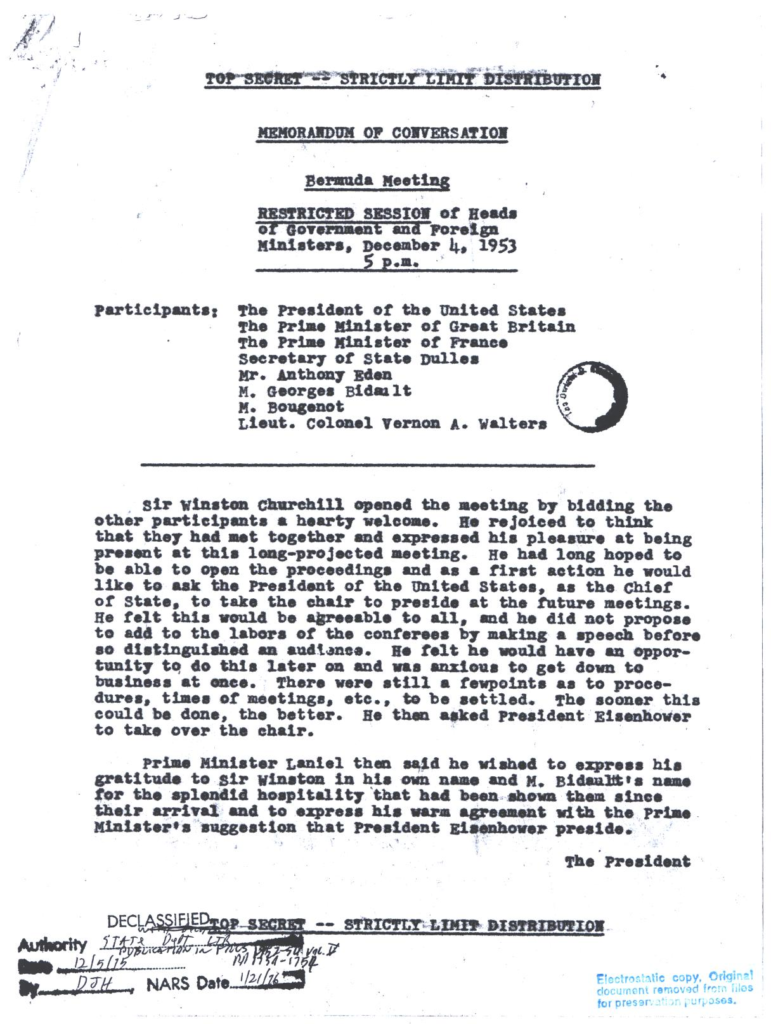
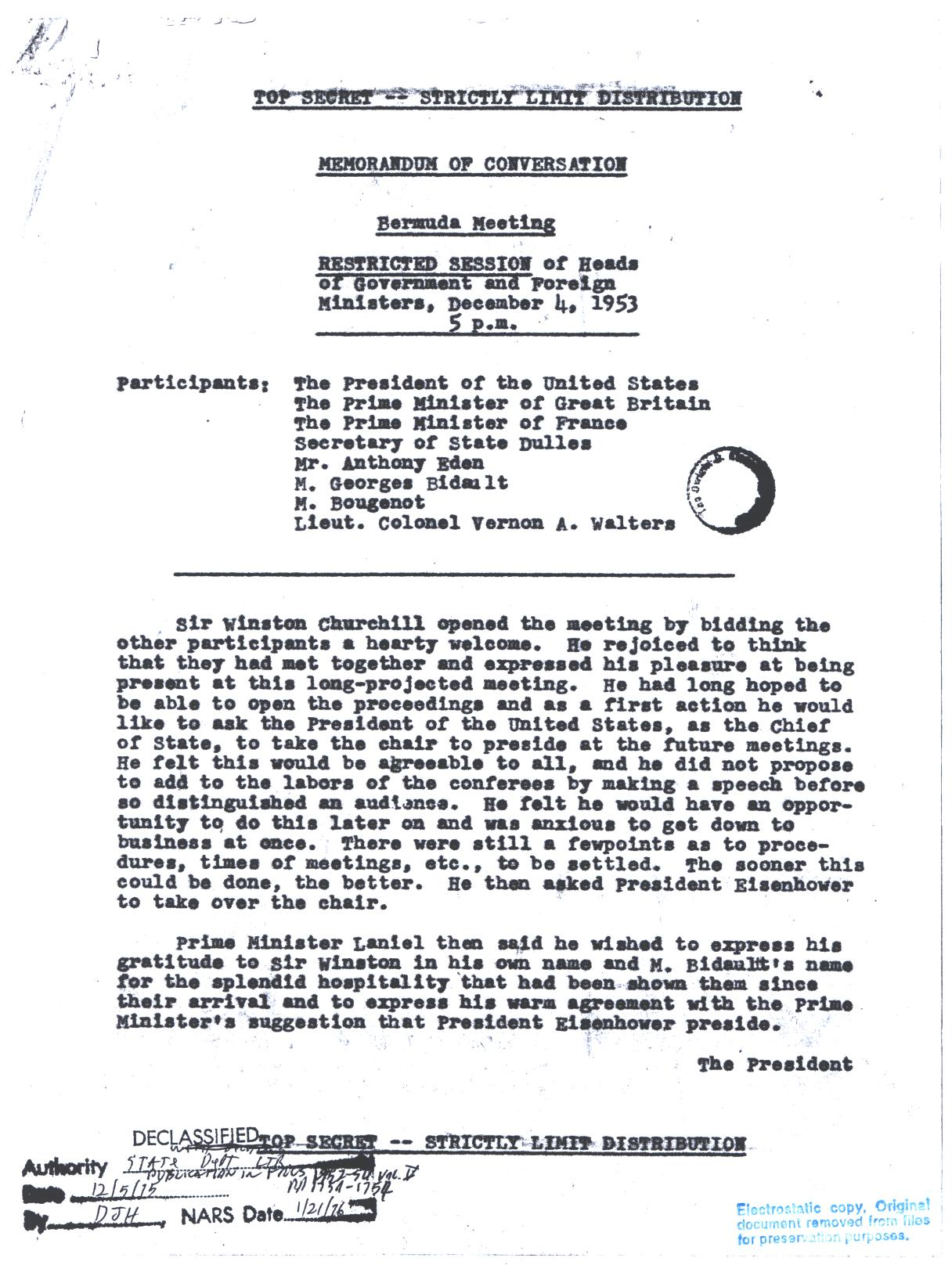
Document
Eisenhower Discusses His Atoms for Peace Proposal with Churchill and Laniel at the Bermuda Conference (1953)
Key Details
Date: December 4, 1953
Created By: No Author
Original or Replica: Original
Era: The Presidency, The Cold War
Collection: Eisenhower Presidential Library
Citations: DDE’s Papers as President, International Meetings Series, Box 1, Bermuda-State Dept Report-Top Secret; NAID #12022750
About
This December 4, 1953 memorandum of conversation records a restricted meeting at the Bermuda Conference between President Dwight D. Eisenhower, British Prime Minister Winston Churchill, French Prime Minister Joseph Laniel, and their foreign policy advisers. Eisenhower used the meeting to privately explain a proposal he was considering for an upcoming address to the United Nations General Assembly. He described the world as being in a near-hysterical state over atomic weapons and wanted to present a serious initiative that emphasized the constructive rather than destructive possibilities of atomic energy.
Eisenhower proposed that the United States, Soviet Union, Britain, and other nuclear powers contribute portions of their uranium and fissionable-material stockpiles to the United Nations. The materials could then be made available to scientists for peaceful purposes, including generating electricity, powering machinery, advancing medicine, and improving agriculture. Eisenhower believed such a program could gradually reduce nuclear stockpiles while creating a new opportunity for negotiations with the Soviet Union. He emphasized that even a small beginning could demonstrate that atomic energy could benefit humanity rather than simply threaten its destruction.
French Prime Minister Laniel strongly supported the proposal, while Churchill requested additional time to consider its implications, particularly the difficulty of separating peaceful nuclear information from military knowledge. Eisenhower stressed that the proposal remained highly secret and that he had not yet made a final decision about delivering the speech.
The document provides an important behind-the-scenes look at Eisenhower presenting the Atoms for Peace concept to key Allied leaders just four days before publicly announcing it at the United Nations.
Document(s)
Used In These Lessons & Programs
Bring History to Life
Join us for engaging learning experiences designed for young minds.