Document
Eisenhower and Churchill Discuss Atomic Weapons, Nuclear Cooperation, and the Risks of Renewed War in Korea (1953)
Key Details
Date: December 5, 1953
Created By: Lewis Strauss
Original or Replica: Original
Era: The Presidency, The Cold War
Collection: Eisenhower Presidential Library
Citations: DDE’s Papers as President, International Meetings Series, Box 1, Bermuda-State Dept Report-Top Secret; NAID #12022753
About
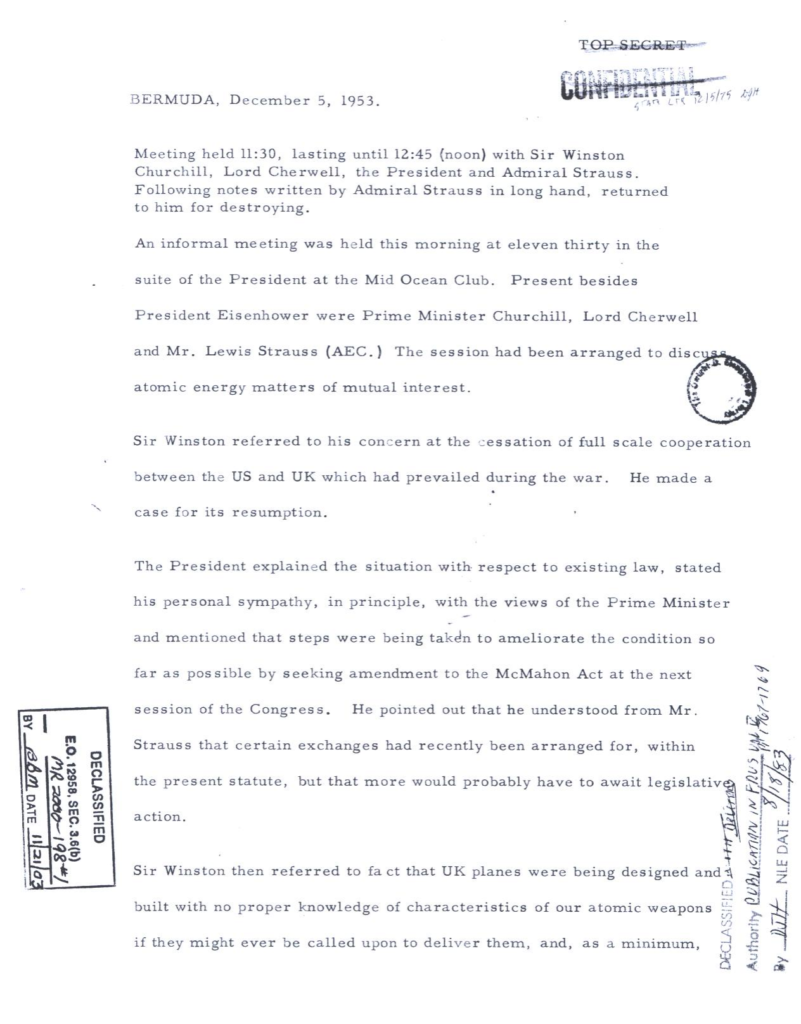
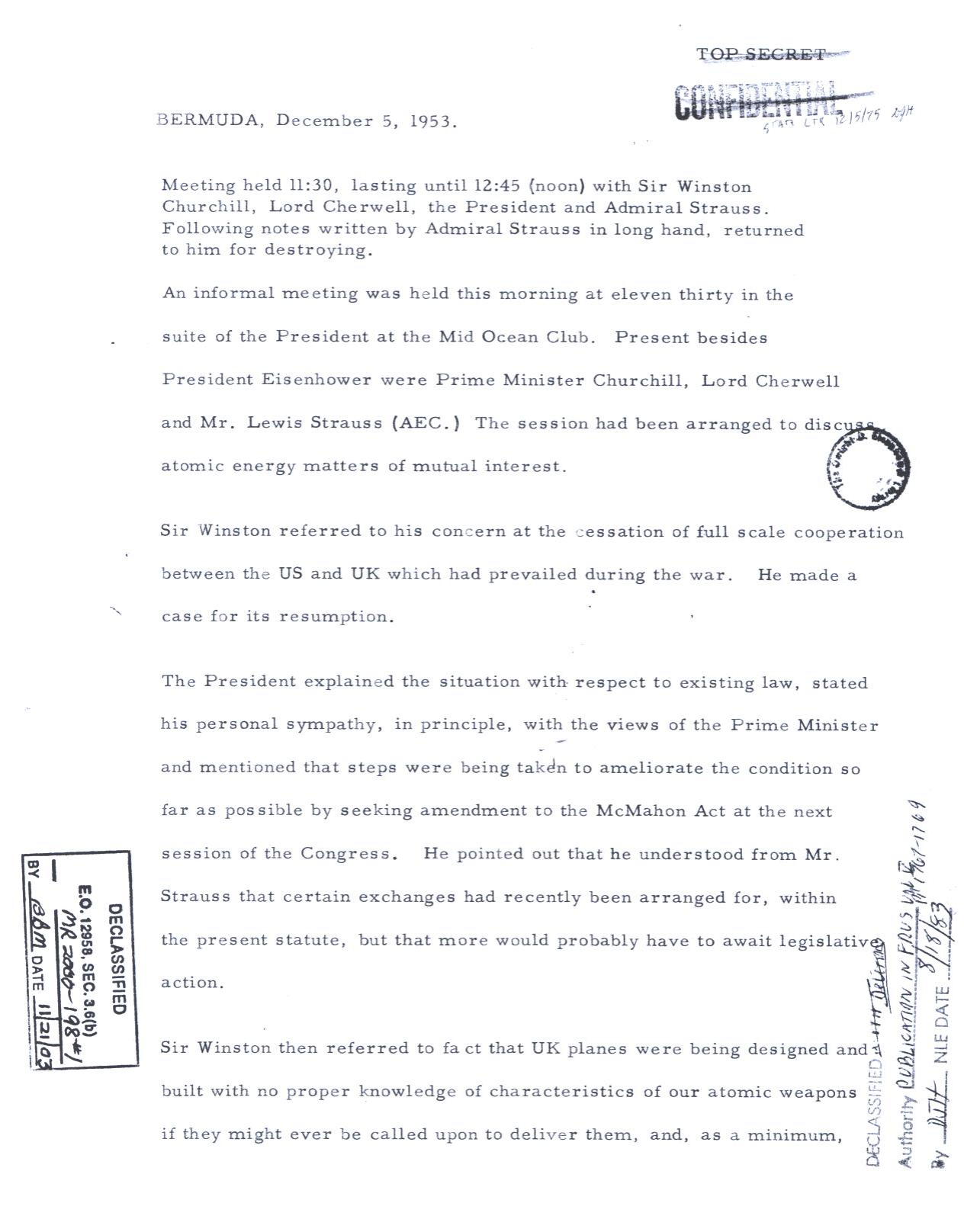
This December 5, 1953 memorandum records a private meeting in Bermuda between President Dwight D. Eisenhower, British Prime Minister Winston Churchill, Lord Cherwell, and Atomic Energy Commission Chairman Lewis Strauss concerning nuclear weapons and U.S.-British atomic cooperation. Churchill urged the restoration of the close nuclear cooperation that had existed during World War II, while Eisenhower explained that American law limited what information could be shared. Eisenhower expressed sympathy with Churchill’s position and noted efforts to amend the McMahon Act to permit greater cooperation. The two leaders also discussed British access to information about American atomic weapons and the possible coordination of U.S. and British nuclear forces.
The conversation then turned to the potential use of atomic weapons if fighting resumed in Korea. Eisenhower stated that nuclear weapons were increasingly being regarded as part of conventional military armament. Churchill worried that their use in Korea might trigger a wider war with the Soviet Union and potentially lead to the destruction of London. Eisenhower argued that, if Communist forces renewed the war, the United States could not again accept restrictions that prevented it from attacking enemy air bases, supplies, and troop concentrations beyond the immediate battlefield.
The meeting also addressed intelligence sharing, previous Anglo-American atomic agreements, and possibilities for rebuilding closer nuclear cooperation. Near the meeting’s conclusion, Churchill raised concerns about an upcoming speech Eisenhower planned to deliver. That speech, given three days later before the United Nations, would become Eisenhower’s famous Atoms for Peace address.
The document provides an unusually candid look at Eisenhower’s nuclear thinking and Anglo-American atomic diplomacy during the early Cold War.
Document(s)
Used In These Lessons & Programs
Bring History to Life
Join us for engaging learning experiences designed for young minds.