Document
Eisenhower Explains the Origins and Meaning of His “Military-Industrial Complex” Warning (1967)
Key Details
Date: June 21, 1967
Created By: Dwight D. Eisenhower
Original or Replica: Original
Era: The Statesman, The Presidency, The Cold War
Collection: Eisenhower Presidential Library
Citations: DDE’s Post-Presidential Papers, 1967 Principal File, Box 5, BE (Business Economics) (6); NAID #16972246
About
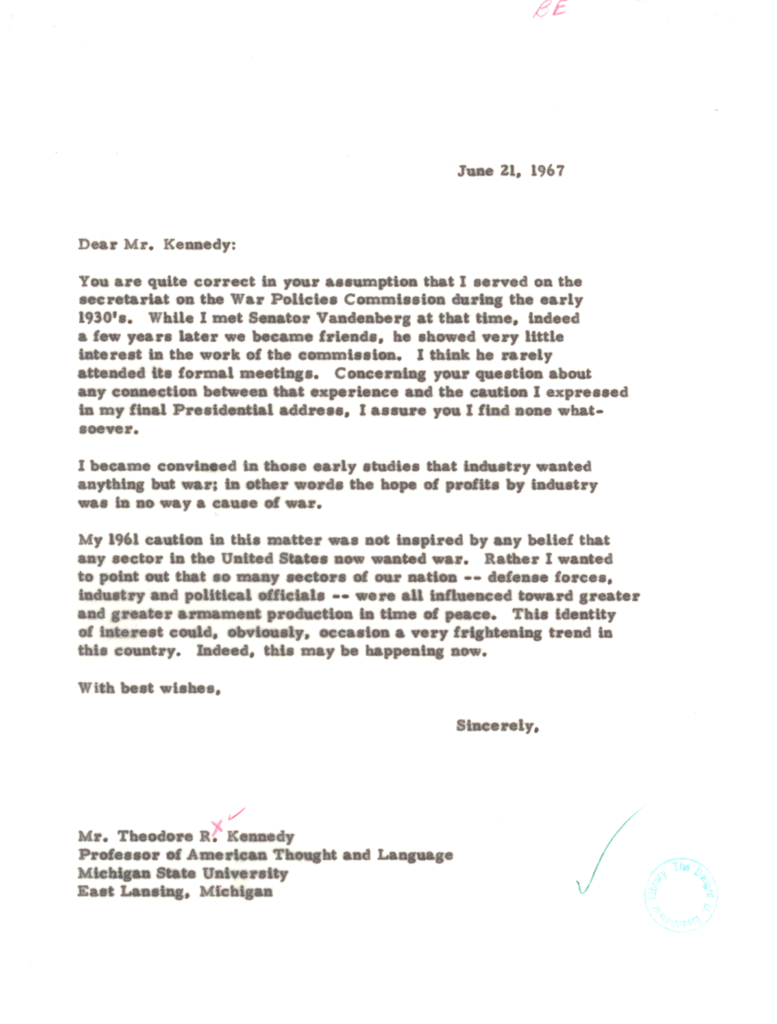
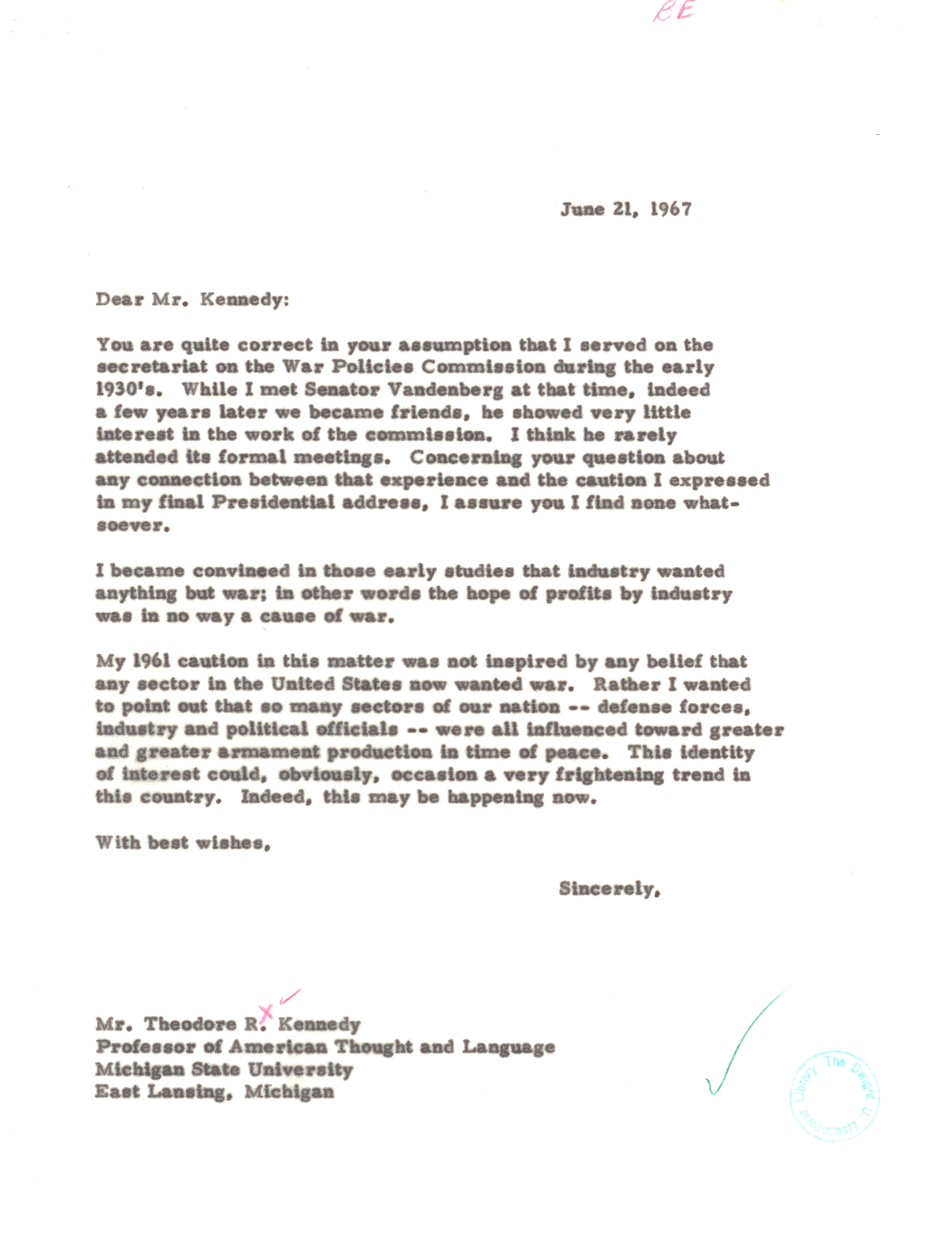
In this June 21, 1967 letter to Michigan State University professor Theodore R. Kennedy, former President Dwight D. Eisenhower reflects on the origins and meaning of his warning about the military-industrial complex in his 1961 Farewell Address. Responding to Kennedy’s question, Eisenhower confirms that he had worked with the War Policies Commission during the early 1930s but rejects the idea that this experience directly inspired his later warning. He recalls concluding from those studies that American industry did not desire war simply to generate profits.
Eisenhower explains that his 1961 warning instead concerned the growing interconnectedness of the armed forces, defense industries, and political officials during peacetime. He feared that these groups could develop shared interests favoring increasingly large levels of armament production even when the nation was not at war. Eisenhower stresses that he did not believe any particular group in the United States actually wanted war. Rather, he worried that the overlapping interests of government, the military, and industry could create a powerful influence encouraging continued military expansion. He concludes that such an “identity of interest” could potentially produce a dangerous trend in American society and suggests that this development might already have been occurring by 1967. The letter provides Eisenhower’s own retrospective explanation of one of the most famous warnings of his presidency.
Used In These Lessons & Programs
Bring History to Life
Join us for engaging learning experiences designed for young minds.