Document
Ralph Williams Recounts the Development of Eisenhower’s “Military-Industrial Complex” Farewell Address (1985)
Key Details
Date: December 28, 1985
Created By: Ralph Williams
Original or Replica: Original
Era: The Statesman, The Presidency, The Cold War
Collection: Eisenhower Presidential Library
Citations: Ralph E. Williams Papers, Box 1, Letters 1985-1988; NAID #16972138
About
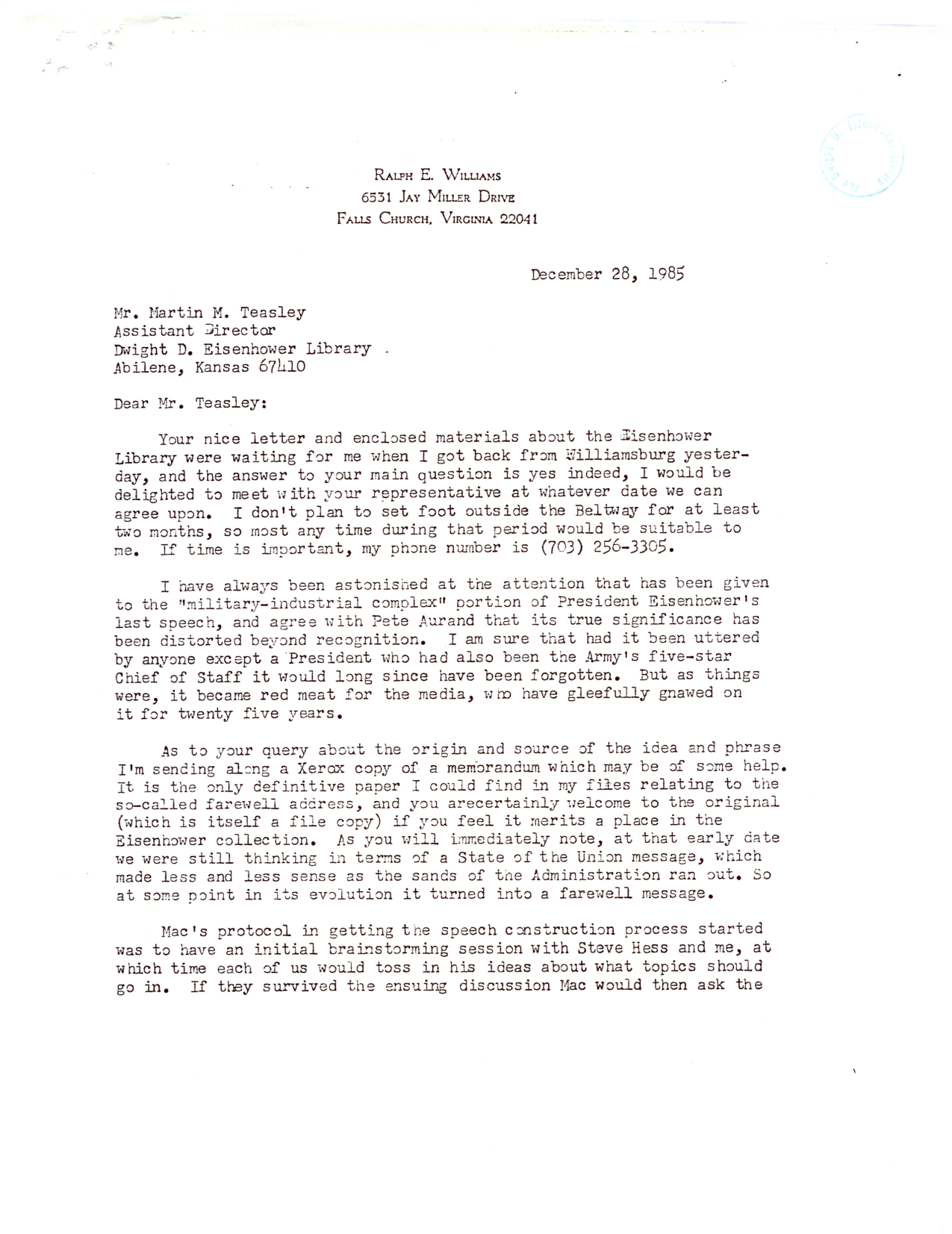
In this December 28, 1985 letter to Martin M. Teasley of the Dwight D. Eisenhower Library, retired Navy Captain Ralph E. Williams provides a firsthand account of the development of President Dwight D. Eisenhower’s Farewell Address. Williams responds to questions about the origins of the speech’s famous warning concerning the “military-industrial complex.” He argues that later attention to this portion of the address had become disproportionate, noting that Eisenhower’s service as the Army’s five-star Chief of Staff made it unlikely that he possessed the hostility toward the military establishment sometimes attributed to the phrase.
Williams explains that the address originally began as a planned State of the Union message before evolving into a farewell speech. According to his account, presidential speechwriter Malcolm Moos began the drafting process by holding brainstorming sessions with Williams and Steve Hess. Participants proposed subjects for inclusion, after which individual writers developed drafts that could be incorporated into the larger speech. Williams states that the famous phrase itself evolved during this process from “war-based” to “military” before appearing in its final form as “military-industrial complex.”
Williams also stresses Eisenhower’s personal role in shaping the final address. He recalls that Eisenhower did not seriously consider the phrase or broader concept until Moos presented the first draft, but that it then struck a responsive chord with the president. Williams emphasizes that Eisenhower would not include anything in a formal speech that he did not personally believe and fully intend to say.
The letter provides valuable firsthand testimony about the collaborative drafting process behind Eisenhower’s Farewell Address and the origins of one of the most famous phrases of his presidency.
Used In These Lessons & Programs

Bring History to Life
Join us for engaging learning experiences designed for young minds.