Document
Eisenhower Urges South Carolina Governor James Byrnes to Support Federal Action Against Racial Discrimination (1953)
Key Details
Date: August 14, 1953
Created By: Dwight D. Eisenhower
Original or Replica: Original
Era: The Presidency, Civil Rights
Collection: Eisenhower Presidential Library
Citations: DDE’s Papers as President, DDE Diary Series, Box 3, DDE Diary Aug-Sept 1953 (2); NAID #12171149
About
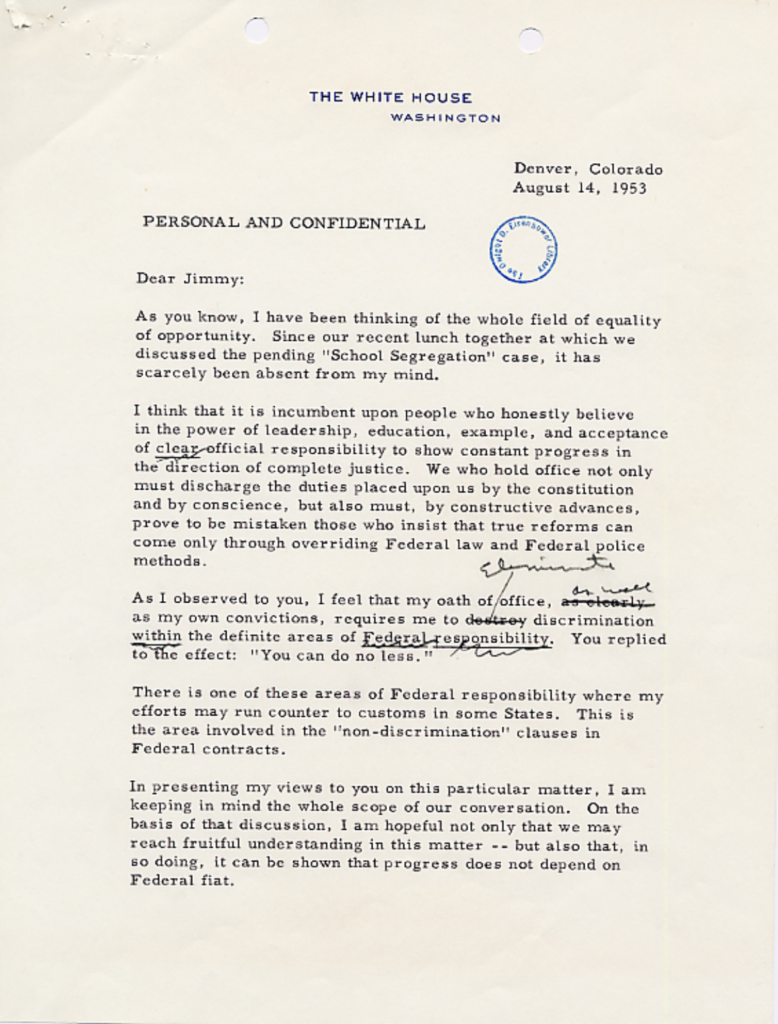
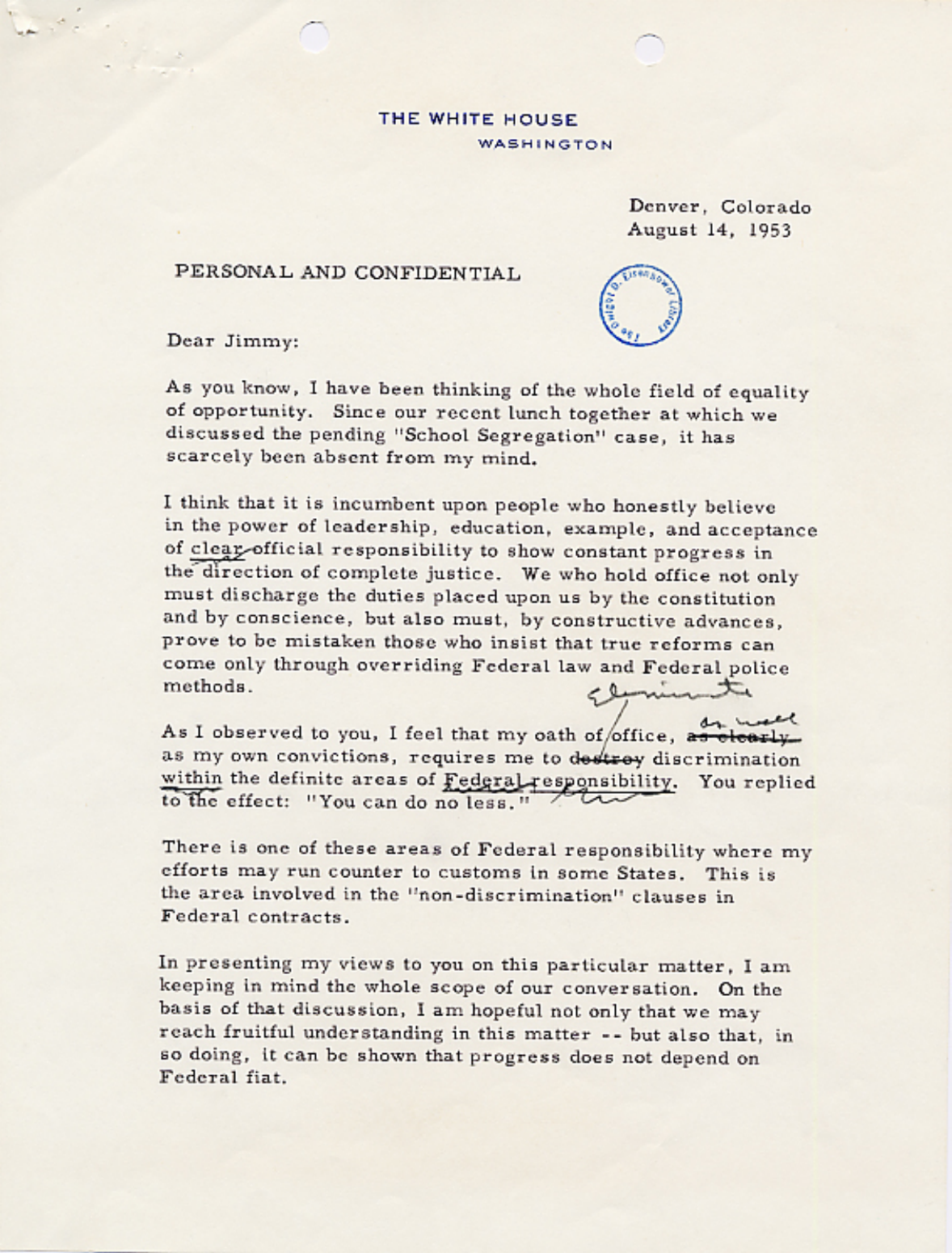
In this August 14, 1953 personal and confidential letter to South Carolina Governor James F. Byrnes, President Dwight D. Eisenhower discusses racial equality and the federal government’s responsibility to combat discrimination. Written while the Supreme Court was considering the school segregation cases that would culminate in Brown v. Board of Education, the letter follows an earlier private conversation between Eisenhower and Byrnes about segregation. Eisenhower argues that progress toward racial justice should be achieved through leadership, education, example, and the responsible exercise of government authority, rather than relying exclusively on sweeping federal intervention.
Eisenhower nevertheless makes clear that he believed the federal government had an obligation to eliminate discrimination within areas of clear federal responsibility. He focuses particularly on nondiscrimination requirements in federal contracts, explaining that his administration was establishing a committee to oversee compliance. Eisenhower asks Byrnes to cooperate with enforcement even when federal requirements conflicted with local customs, using a hypothetical federal contract at the Charleston Navy Yard to illustrate his point.
The president argues that such cooperation could demonstrate that racial progress did not necessarily require what opponents viewed as excessive federal action. At the same time, Eisenhower states that the government must make “constant and distinct progress” toward eliminating unjust practices. He specifically identifies equal consideration in federal employment regardless of race or color as a fundamental right. Eisenhower concludes by asking Byrnes to discuss these ideas with other governors who shared his general outlook.
The document provides a revealing look at Eisenhower’s civil rights philosophy before Brown v. Board of Education, showing his preference for gradual progress and cooperation while also asserting the federal government’s responsibility to eliminate racial discrimination within its own authority.
Used In These Lessons & Programs
Bring History to Life
Join us for engaging learning experiences designed for young minds.