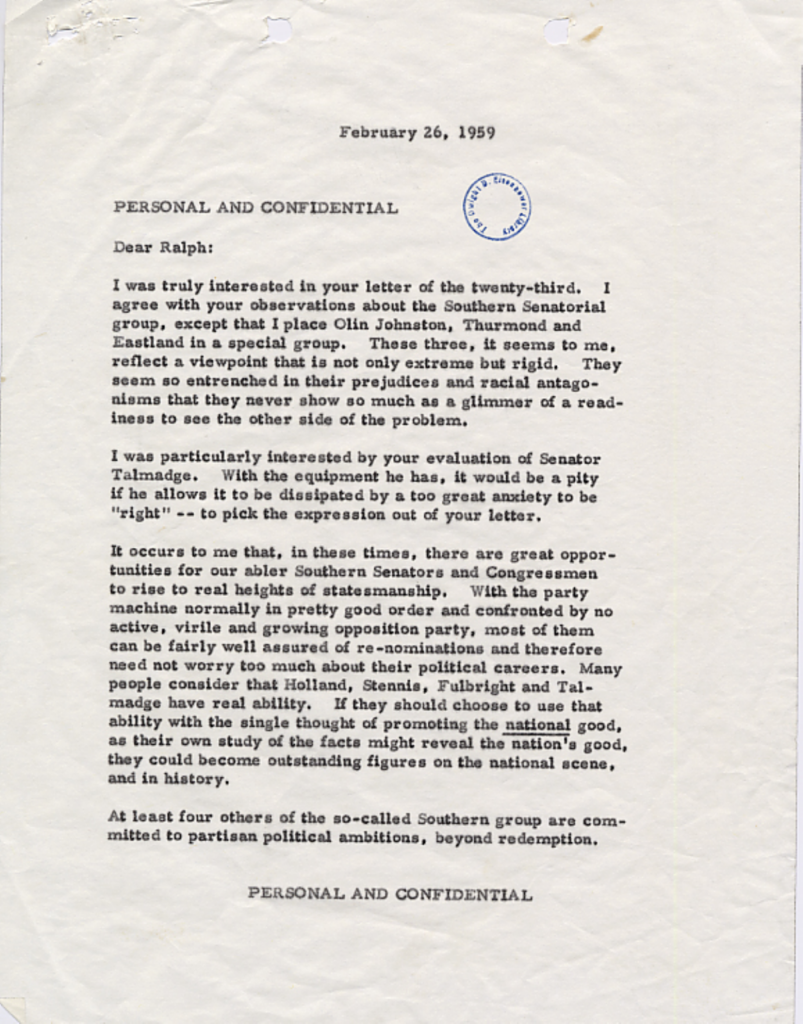
Document
Eisenhower Discusses Southern Resistance, Civil Rights, and His Approach to Racial Integration (1959)
Key Details
Date: February 26, 1959
Created By: Dwight D. Eisenhower
Original or Replica: Original
Era: The Presidency, Civil Rights
Collection: Eisenhower Presidential Library
Citations: DDE’s Papers as President, DDE Diary Series, Box 39, DDE Dictation February 1959; NAID #12188395
About
In this February 26, 1959 personal and confidential letter to Atlanta newspaper editor Ralph E. McGill, President Dwight D. Eisenhower offers candid observations about Southern political leaders and explains his philosophy toward civil rights and racial integration. Eisenhower agrees with McGill’s assessment of many Southern senators but singles out Olin Johnston, Strom Thurmond, and James Eastland as particularly rigid, writing that racial prejudice and antagonism prevented them from seriously considering opposing viewpoints. He expresses greater hope for several other Southern senators, believing that some could rise above regional and partisan pressures and demonstrate genuine statesmanship.
Eisenhower then explains why he favored moderation in addressing racial issues. He states unequivocally that America could not fully realize its ideals until individual dignity and equality before the law became a reality. At the same time, he argues that relying heavily on coercive law could produce greater resistance when large portions of the public remained bitterly opposed. Instead, Eisenhower emphasizes education, persuasion, leadership, and personal example, while acknowledging that federal law remained necessary in appropriate circumstances.
Eisenhower concludes by defending the civil rights legislative program he had placed before Congress as modest but effective. He hoped that gradual progress through moderation would draw Americans away from extremes and toward broader acceptance of racial equality. The letter provides an unusually candid explanation of Eisenhower’s personal views on civil rights and his preference for gradual, moderate methods of achieving integration.
Used In These Lessons & Programs
Bring History to Life
Join us for engaging learning experiences designed for young minds.