Document
Eisenhower Explains Why He Opposes Publicly Attacking Senator Joseph McCarthy (1953)
Key Details
Date: July 21, 1953
Created By: Dwight D. Eisenhower and James Hagerty
Original or Replica: Original
Era: The Presidency, McCarthyism and the Red Scare
Collection: Eisenhower Presidential Library
Citations: DDE’s Papers as President, Name Series, Box 18, Hazlett Swede 1953 (1); NAID #16610971
About
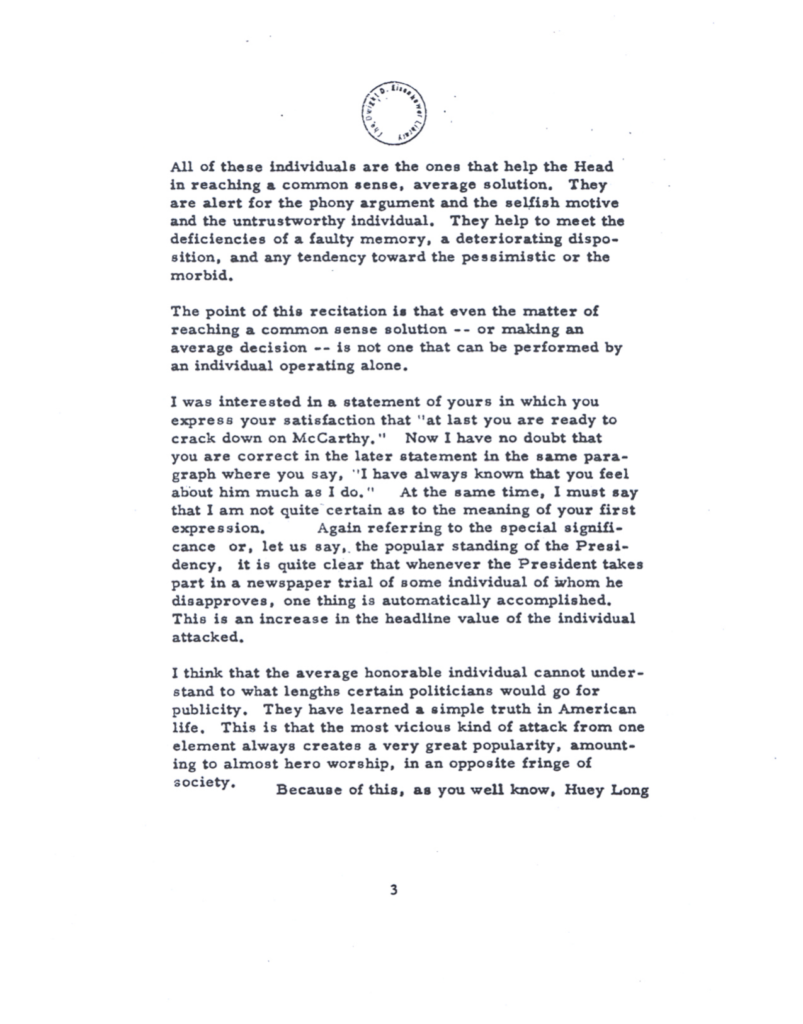
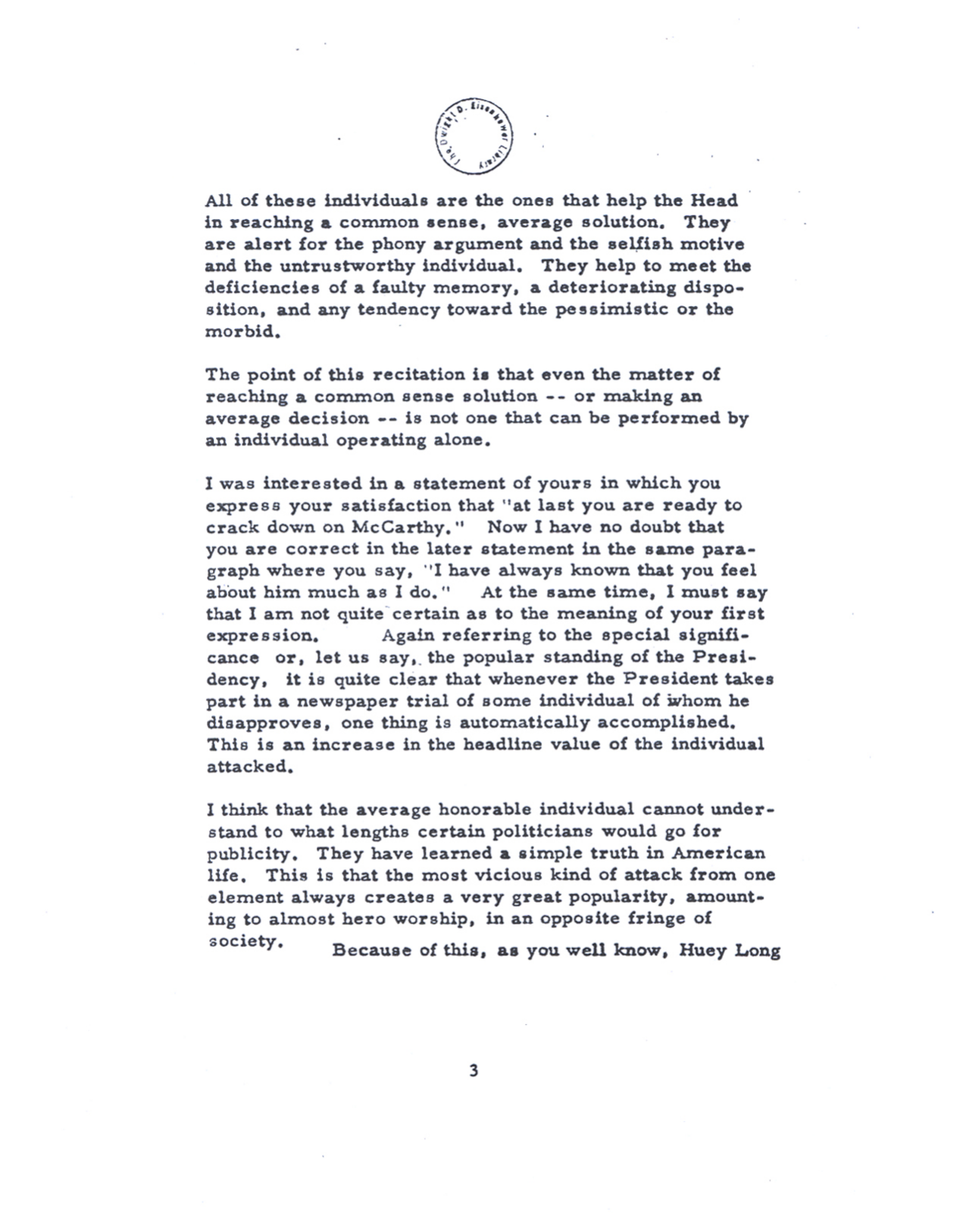
In this 1953 letter to his longtime friend Edward “Swede” Hazlett, President Dwight D. Eisenhower explains his approach toward Senator Joseph McCarthy and the controversy surrounding McCarthy’s anti-Communist investigations. Eisenhower argues that presidential decision-making requires consultation with trusted advisers rather than relying on the judgment of one individual. He then responds to Hazlett’s apparent desire for Eisenhower to “crack down on McCarthy,” explaining why he believed a direct presidential attack would be counterproductive.
Eisenhower argues that politicians such as McCarthy could gain publicity and support when attacked by prominent opponents. Drawing a comparison to Huey Long, he suggests that public condemnation could strengthen McCarthy by allowing him to portray himself as an underdog. Instead, Eisenhower favors what he calls a “positive approach.” He advocates supporting fair investigations, defending people who were unjustly attacked, promoting decency and justice, and presenting factual responses to accusations rather than engaging in personal confrontation. Eisenhower believed these less dramatic methods would ultimately earn the respect of fair-minded Americans and weaken McCarthy more effectively than a highly publicized presidential attack. The letter provides important insight into Eisenhower’s deliberately restrained strategy for confronting McCarthyism during the early years of his presidency.
Used In These Lessons & Programs
Bring History to Life
Join us for engaging learning experiences designed for young minds.