Document
Montgomery Urges Eisenhower to Centralize Command for the Allied Advance Toward the Rhine (1944)
Key Details
Date: December 29, 1944
Created By: Bernard Montgomery
Original or Replica: Original
Era: The General, The Ardennes Offensive
Collection: Eisenhower Presidential Library
Citations: DDE’s Pre-Presidential Papers, Principal File, Box 83, Montgomery, Bernard (11); NAID #12125686
About
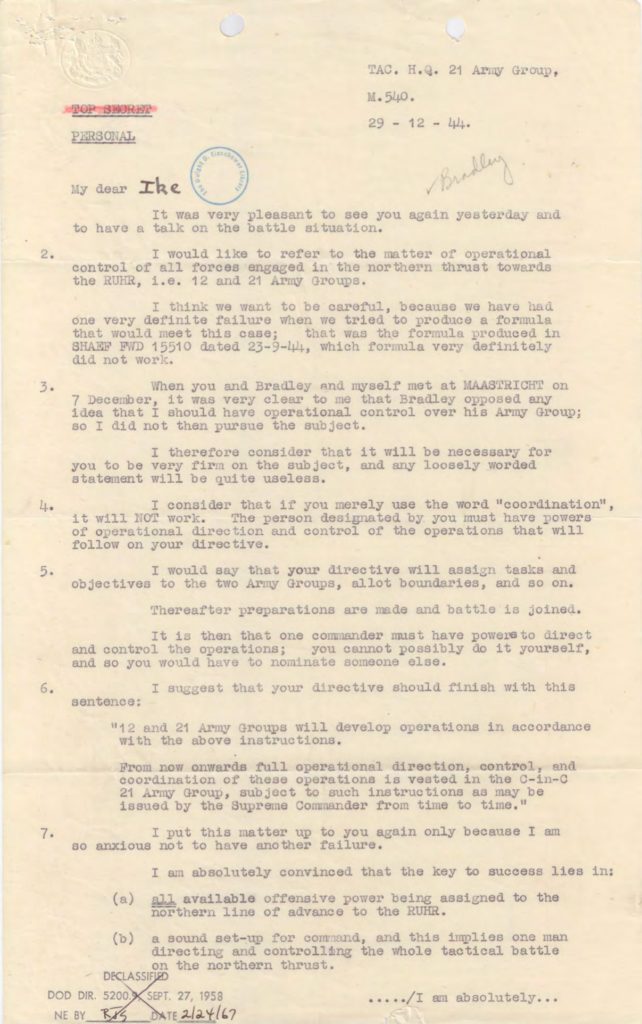
In this December 29, 1944 personal letter to Supreme Allied Commander Dwight D. Eisenhower, Field Marshal Bernard Montgomery argues for a centralized command structure for future Allied operations toward the Rhine and Ruhr. Writing during the Battle of the Bulge, Montgomery refers to a conversation with Eisenhower the previous day and recommends that the forces of both the 12th and 21st Army Groups involved in the northern advance be placed under a single commander. He warns that previous attempts to coordinate operations without clearly establishing unified authority had failed and should not be repeated.
Montgomery emphasizes that simple “coordination” between Army Groups would be insufficient. He argues that whoever Eisenhower selected must possess genuine authority to direct and control operations. Under Montgomery’s proposal, Eisenhower would establish the overall objectives and boundaries for the two Army Groups, while a designated commander would control the tactical battle. Montgomery identifies two requirements for success: concentrating all available offensive strength along the northern route toward the Ruhr and placing that offensive under the direction of one commander.
The letter also exposes an important disagreement within the Allied high command. Montgomery notes that General Omar Bradley had previously opposed placing his Army Group under Montgomery’s command, but Montgomery insists that Eisenhower must firmly settle the issue. He warns that failure to establish unified command could result in another military setback. Despite the forcefulness of his argument, Montgomery closes the letter warmly, signing himself Eisenhower’s “very devoted friend” and adding a handwritten note telling Eisenhower not to bother answering.
The document provides a revealing look at Allied command tensions during the Battle of the Bulge and Montgomery’s effort to influence the command structure for the coming advance toward the Rhine.
Used In These Lessons & Programs
Bring History to Life
Join us for engaging learning experiences designed for young minds.