Document
Eisenhower Writes Winston Churchill About Nuclear Weapons, Anglo-American Relations, and the Danger of Future War (1956)
Key Details
Date: April 27, 1956
Created By: Dwight D. Eisenhower
Original or Replica: Original
Era: The Presidency, The Cold War
Collection: Eisenhower Presidential Library
Citations: DDE’s Papers as President, DDE Diary Series, Box 14, April 1956 Miscellaneous (1); NAID #12022974
About
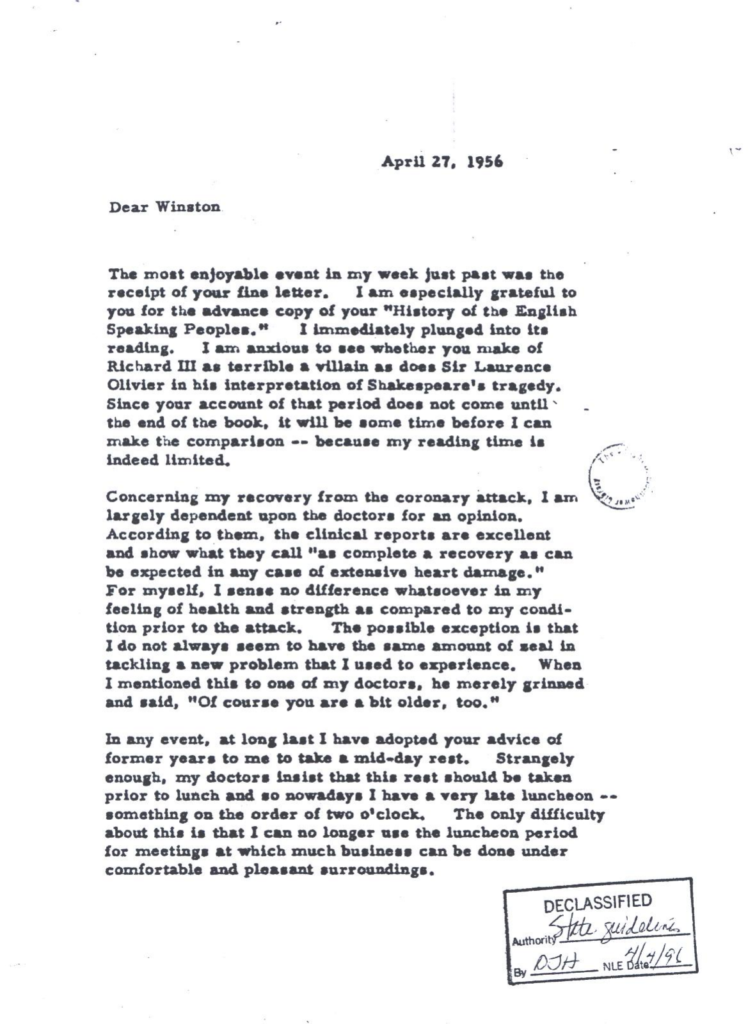
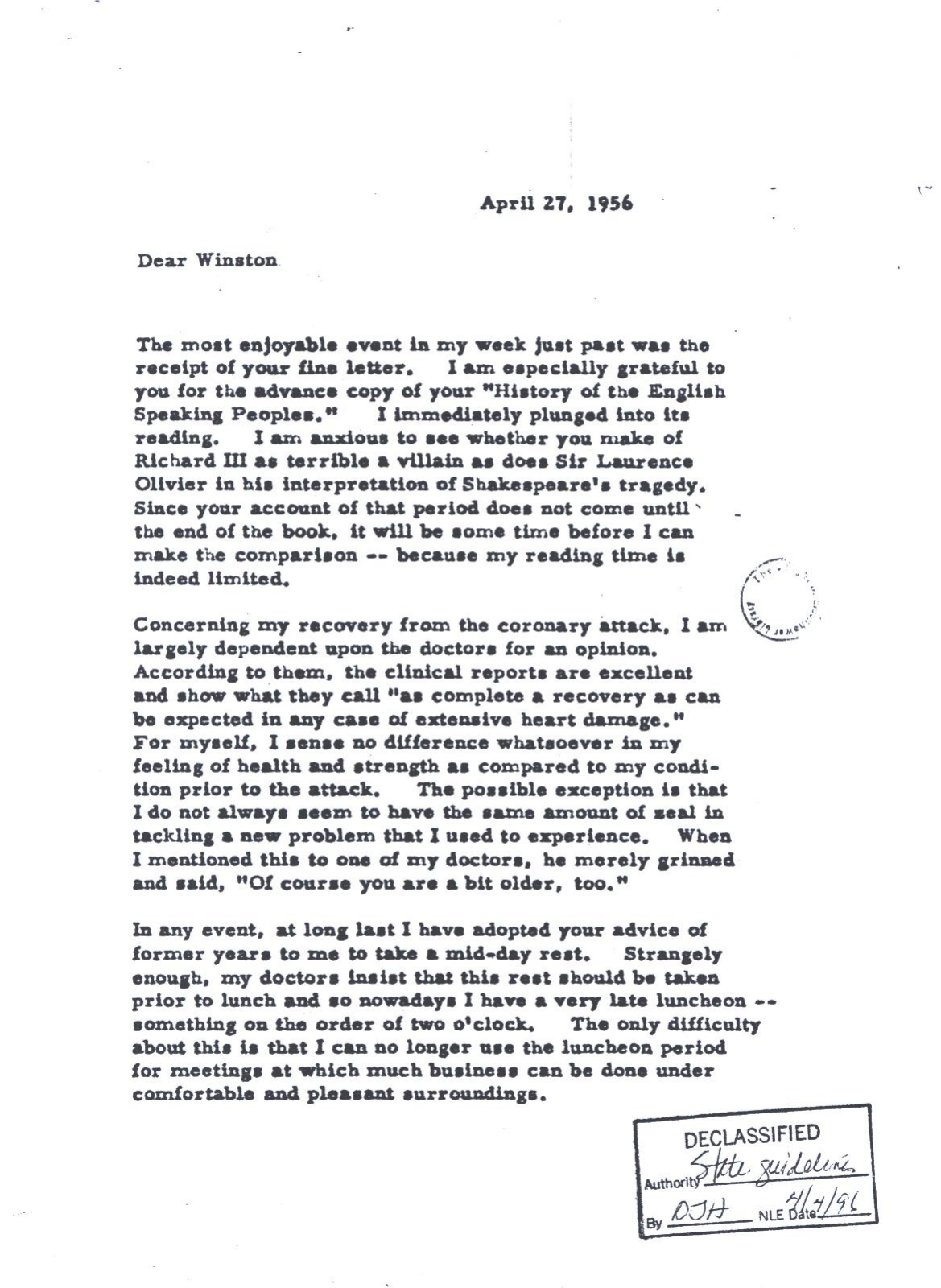
In this April 27, 1956 personal letter to former British Prime Minister Winston Churchill, President Dwight D. Eisenhower discusses their friendship, his health, relations between the United States and Great Britain, and the dangers posed by nuclear weapons. Eisenhower begins by thanking Churchill for an advance copy of his History of the English-Speaking Peoples and reports that he had largely recovered from his 1955 heart attack, although his doctors continued to encourage him to rest during the workday.
Eisenhower then addresses the Anglo-American relationship, clarifying that earlier comments were not intended to suggest serious problems between the two countries. He praises British Foreign Secretary Selwyn Lloyd and Prime Minister Anthony Eden and expresses confidence in continued cooperation. Eisenhower also agrees with Churchill that Britain had lost valuable time and money in developing its atomic capabilities, partly because restrictions imposed by the U.S. Congress had limited nuclear cooperation between the two allies. He nevertheless notes that American law had recently become less restrictive and expected further liberalization.
The most significant portion of the letter concerns the possibility of nuclear war. Eisenhower questions Churchill’s hope that the unimaginable destruction of nuclear weapons would necessarily prevent another major conflict. While acknowledging that nuclear deterrence might reduce the likelihood of war, Eisenhower warns that a desperate struggle between East and West could still lead both sides to use such weapons. Drawing on his experience in World War II, he recalls that Nazi Germany continued fighting even after defeat had become inevitable, producing additional destruction and ultimately Germany’s division between East and West.
The document provides a revealing glimpse into the personal relationship between Eisenhower and Churchill and their private thinking about nuclear deterrence, showing Eisenhower’s concern that even the threat of catastrophic destruction could not guarantee that nations would avoid war.
Used In These Lessons & Programs
Bring History to Life
Join us for engaging learning experiences designed for young minds.