Document
Eisenhower Explains His Battle of the Bulge Strategy and Defends Allied Command Arrangements to Montgomery (1944)
Key Details
Date: December 31, 1944
Created By: Dwight D. Eisenhower
Original or Replica: Original
Era: The General, The Ardennes Offensive
Collection: Eisenhower Presidential Library
Citations: DDE’s Pre-Presidential Papers, Principal File, Box 83, Montgomery, Bernard (11); NAID #12125692
About
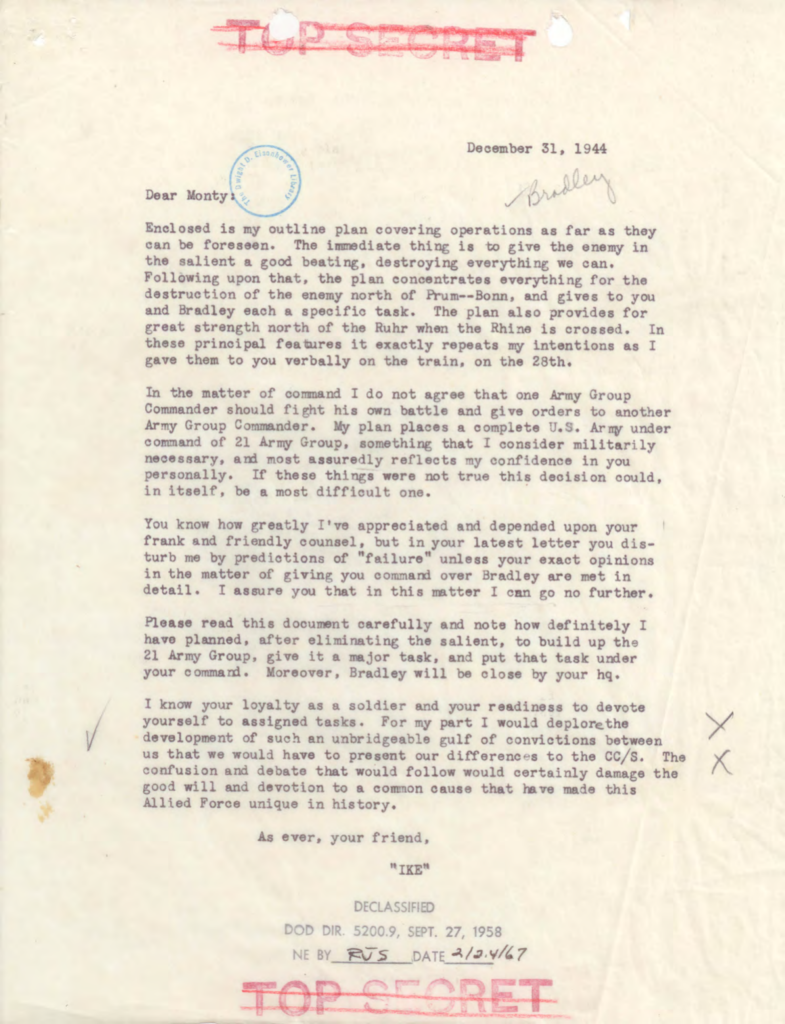
In this December 31, 1944 letter to British Field Marshal Bernard Montgomery, Supreme Allied Commander Dwight D. Eisenhower explains his strategy for defeating German forces in the Ardennes and addresses disagreements over the command structure of the Allied armies. Eisenhower encloses his operational plan and emphasizes that the immediate objective is to strike the German salient as forcefully as possible before concentrating Allied strength against German forces north of the Prüm-Bonn line. His longer-term plan calls for building overwhelming strength north of the Ruhr once Allied forces cross the Rhine.
Eisenhower then directly addresses Montgomery’s concerns about Allied command. He rejects the principle that one Army Group commander should fight his own battle while issuing orders to another Army Group commander. Nevertheless, Eisenhower’s plan temporarily places a complete American army under Montgomery’s 21st Army Group, a decision Eisenhower says demonstrates his personal confidence in Montgomery. He also assures him that, after eliminating the Ardennes salient, the 21st Army Group would be strengthened and assigned an important role in future operations.
The letter also reveals growing personal tension between the two commanders. Eisenhower tells Montgomery that he values his frank advice but objects to predictions of failure if Montgomery’s recommendations regarding General Omar Bradley are not followed. Eisenhower warns that allowing their disagreement to develop into an “unbridgeable gulf” would force him to present their differences to the Combined Chiefs of Staff, creating a damaging public command dispute.
The document provides a revealing look at Eisenhower’s leadership during the Battle of the Bulge, his strategic plans for the advance toward the Rhine, and his efforts to manage serious disagreements among senior Allied commanders.
Used In These Lessons & Programs
Bring History to Life
Join us for engaging learning experiences designed for young minds.