Document
Acting Attorney General William Rogers Warns That the Senate’s Jury-Trial Amendment Could Weaken Enforcement of the Civil Rights Act of 1957
Key Details
Date: August 9, 1957
Created By: William P. Rogers
Original or Replica: Original
Era: The Presidency, Civil Rights
Collection: Eisenhower Presidential Library
Citations: E. Frederic Morrow Records, Box 9, Civil Rights Bill; NAID #12090722
About
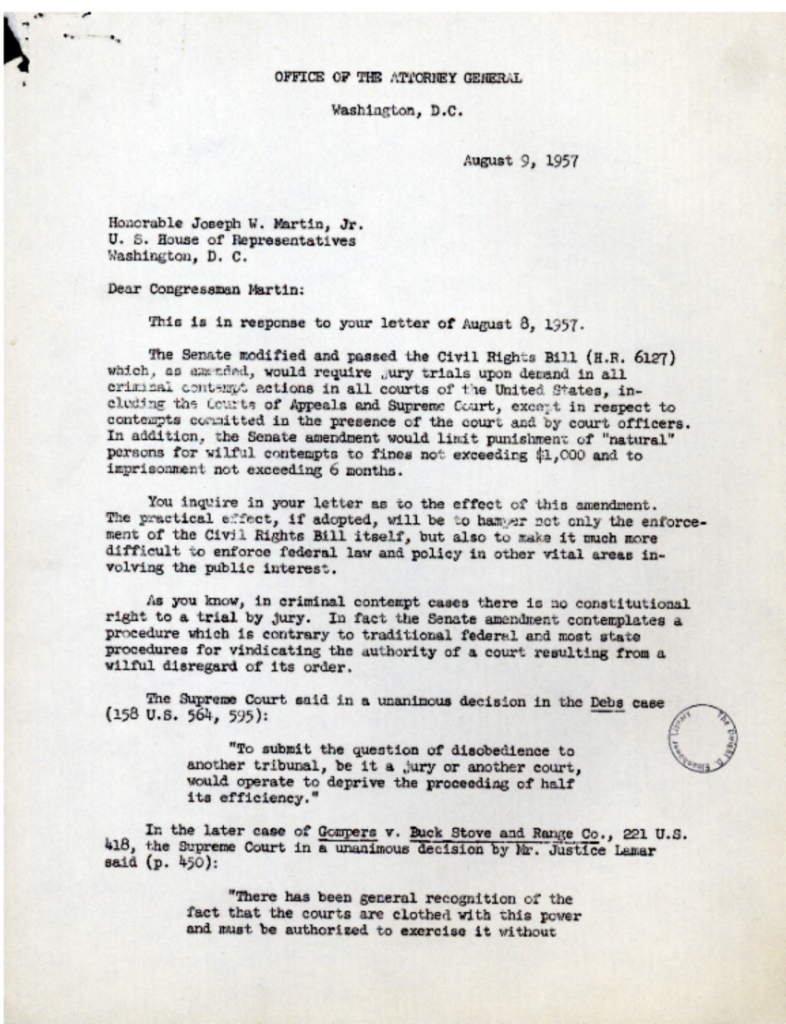
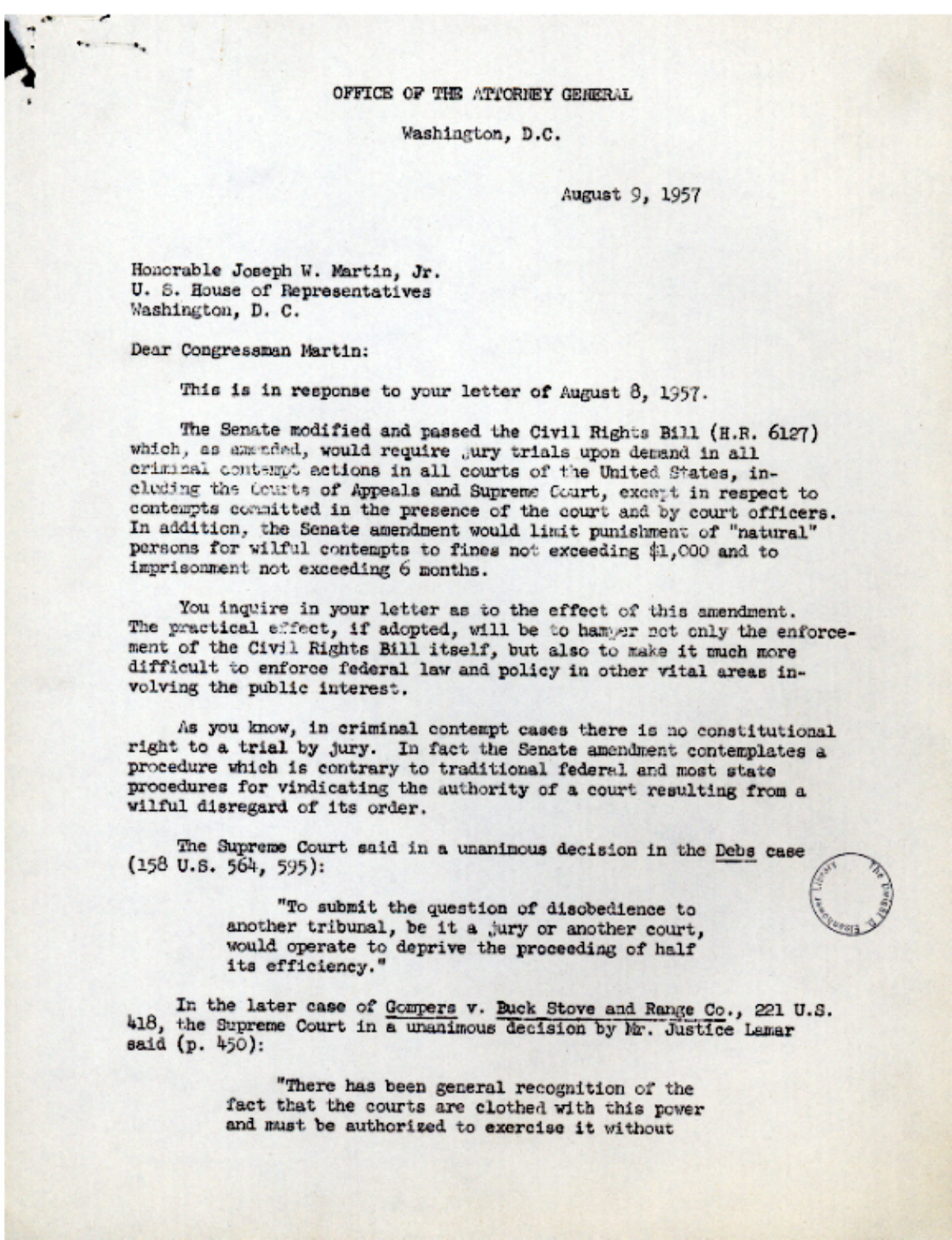
In this August 9, 1957 letter to Congressman Joseph W. Martin Jr., Acting Attorney General William P. Rogers explains the Eisenhower administration’s concerns about a Senate amendment to the proposed Civil Rights Act of 1957. The amendment would require jury trials in criminal contempt cases in federal courts and limit punishment for certain contempts. Rogers argues that although the provision was being debated as part of the civil rights legislation, its consequences would extend far beyond civil rights and could weaken the federal government’s ability to enforce court orders in numerous areas.
Rogers emphasizes that courts traditionally possessed the authority to punish criminal contempt without a jury trial. He argues that this power was essential because courts needed to enforce their own orders quickly and effectively. Requiring a separate jury proceeding could create delays, increase costs, and encourage individuals or organizations to disregard federal injunctions. To support this position, the letter cites decisions from the U.S. Supreme Court and several state supreme courts defending the judiciary’s traditional contempt authority.
The letter then presents warnings from several federal agencies—including the National Labor Relations Board, Department of Labor, Securities and Exchange Commission, Atomic Energy Commission, Federal Trade Commission, and Justice Department’s Antitrust Division—that the amendment could interfere with enforcement of labor, securities, atomic energy, antitrust, and other federal laws.
Rogers concludes that federal courts had played a vital role in the nation’s progress and urges Congress to consider carefully whether it should weaken their traditional enforcement authority.
The document provides an important look at the legislative struggle surrounding the Civil Rights Act of 1957 and the Eisenhower administration’s concern that the Senate’s jury-trial amendment could weaken enforcement of federal court orders.
Used In These Lessons & Programs
Bring History to Life
Join us for engaging learning experiences designed for young minds.