Document
Eisenhower Responds to Theodore Repplier’s Proposal for a Humanitarian Campaign Against Communism (1955)
Key Details
Date: August 3, 1955
Created By: Dwight D. Eisenhower
Original or Replica: Original
Era: The Presidency, The Cold War
Collection: Eisenhower Presidential Library
Citations: DDE’s Papers as President, Administration Series, Box 30, Nelson Rockefeller 1952-55 (3); NAID #12022935
About
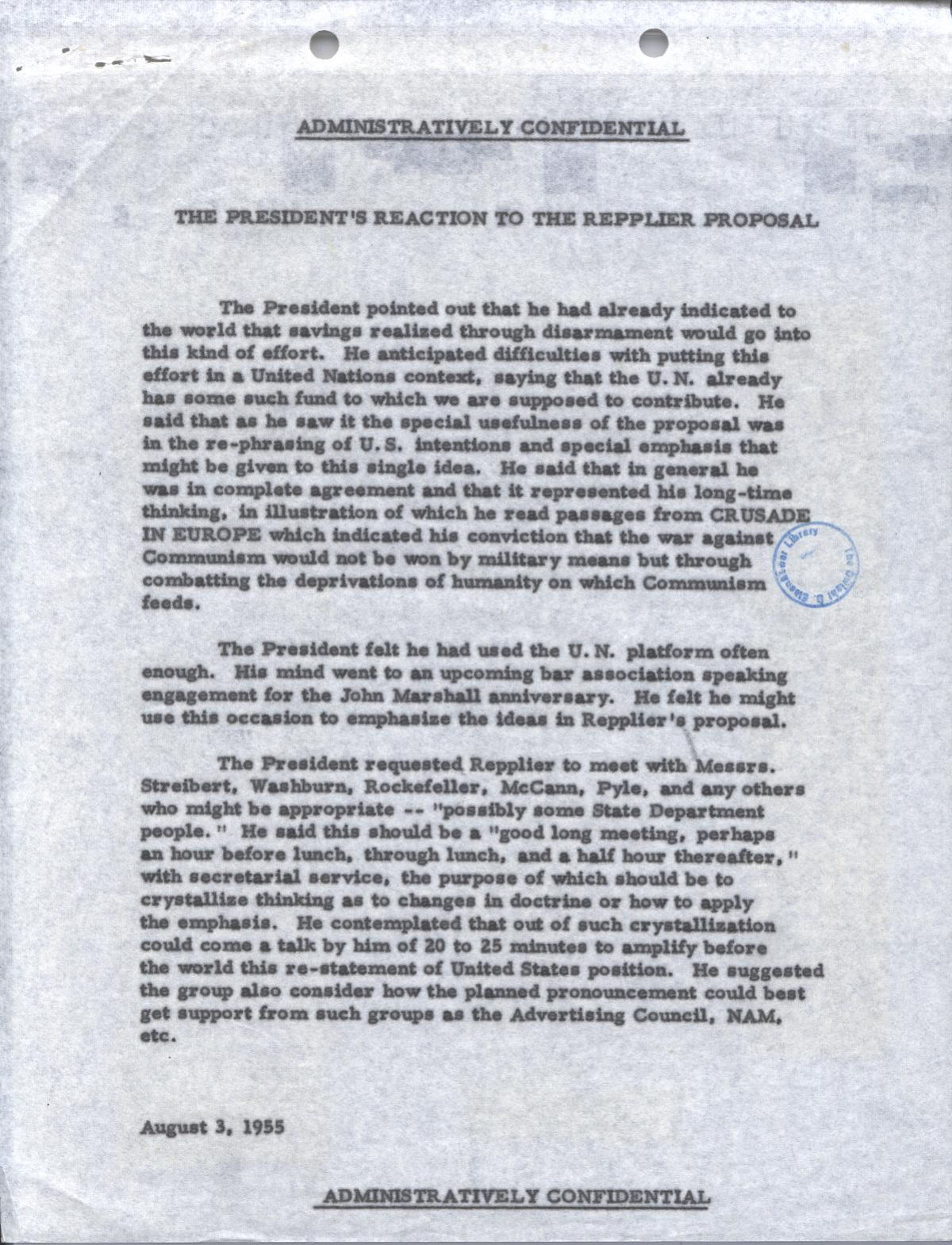
This August 3, 1955 administratively confidential memorandum records President Dwight D. Eisenhower’s reaction to Theodore S. Repplier’s proposal for strengthening the United States’ ideological campaign against Communism. Repplier had recommended presenting existing American foreign assistance programs as part of a larger humanitarian “crusade” against suffering and poverty. Eisenhower responds favorably to the proposal’s central idea, noting that he had already suggested that money saved through future disarmament could be redirected toward similar humanitarian efforts. However, he questions whether Repplier’s proposed program should operate through the United Nations, since an international fund already existed to which the United States was expected to contribute.
Eisenhower particularly approves of Repplier’s suggestion that the United States reframe how it presented its intentions to the world. The president connects this idea to his long-held belief that the Cold War could not ultimately be won through military power alone. Referring to passages from Crusade in Europe, Eisenhower argues that victory over Communism would instead depend upon successfully competing for the loyalty and aspirations of people—the same human needs and frustrations that Communist ideology attempted to exploit.
Rather than immediately delivering another United Nations address, Eisenhower considers using an upcoming speech marking the anniversary of John Marshall to develop these themes. He also directs Repplier to meet with several advisers and possibly State Department officials to refine the proposal. Eisenhower envisioned eventually delivering a 20- to 25-minute speech that would clearly restate America’s purpose before the world and suggested seeking support from outside organizations to amplify the message.
The document provides a revealing look at Eisenhower’s belief that defeating Communism required not only military strength but also a persuasive positive vision of American values, humanitarianism, and peaceful international leadership.
Used In These Lessons & Programs

Bring History to Life
Join us for engaging learning experiences designed for young minds.