Document
Montgomery Outlines the 21st Army Group’s Planned Offensive Toward the Rhine and Ruhr (1944)
Key Details
Date: December 16, 1944
Created By: Bernard Montgomery
Original or Replica: Original
Era: The General, The Ardennes Offensive
Collection: Eisenhower Presidential Library
Citations: DDE’s Pre-Presidential Papers, Principal File, Box 83, Montgomery Bernard (11); NAID #12125645
About
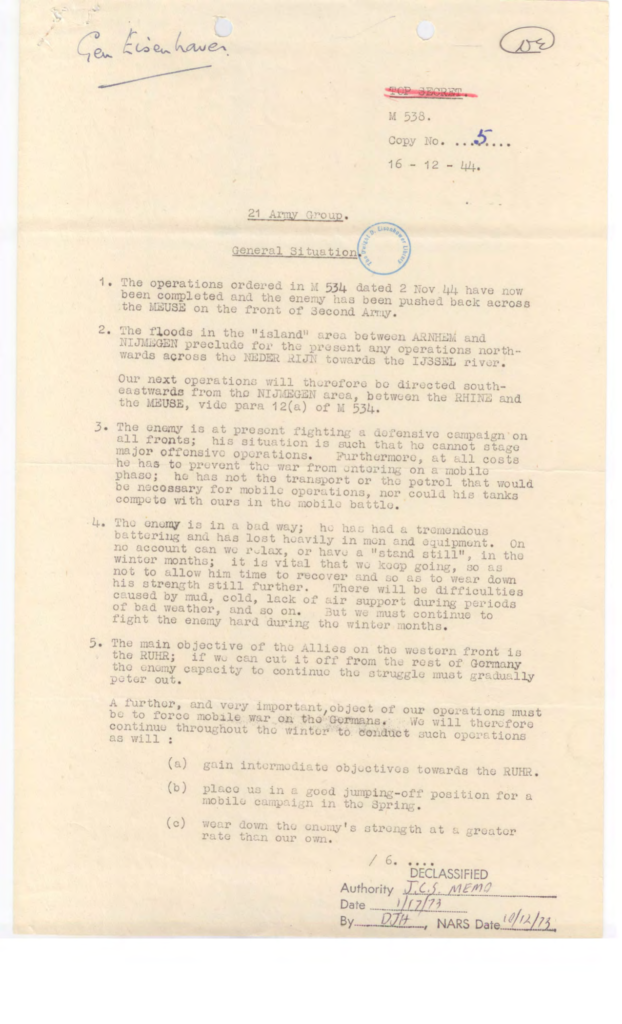
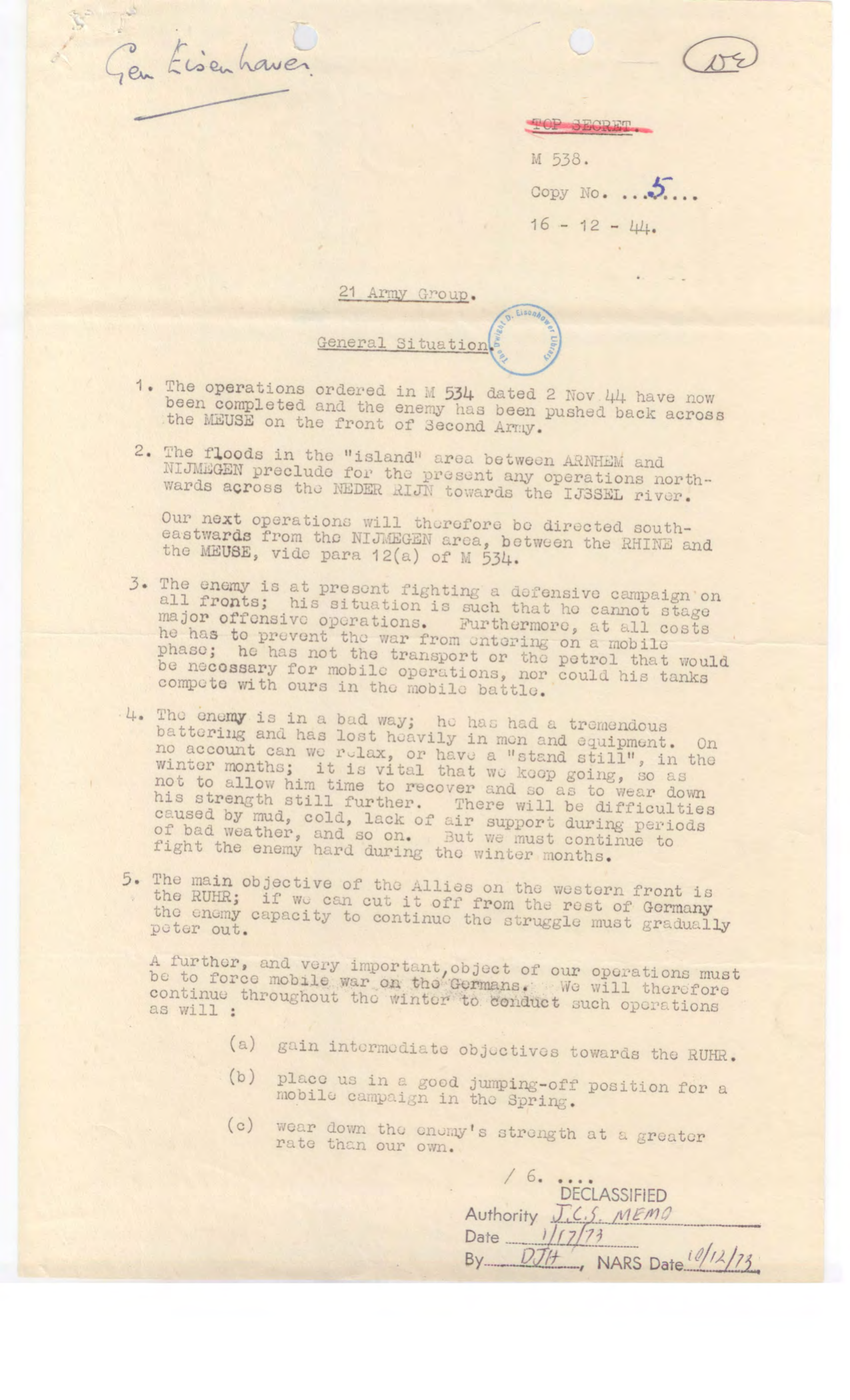
This December 16, 1944 21st Army Group operational plan, issued by Field Marshal Bernard Montgomery, outlines Allied strategy for a major offensive toward the Rhine and Ruhr. Written immediately before the German Ardennes offensive dramatically altered Allied plans, the document describes the German Army as weakened by months of fighting but warns that Allied forces must continue applying pressure throughout the winter. Montgomery identifies the Ruhr as the principal Allied objective, arguing that its loss would seriously weaken Germany’s ability to continue the war. The plan therefore seeks to wear down German forces while positioning Allied armies for a major mobile campaign in the spring.
Montgomery proposes destroying German forces between the Rhine and Meuse Rivers and then crossing the Rhine before advancing north of the Ruhr. A central component was Operation Veritable, in which the First Canadian Army would launch a powerful southeastward offensive between the Rhine and Meuse. The operation was intended to clear German forces from the area, establish a firm position along the Rhine, and prepare suitable crossing points. Montgomery hoped to begin the offensive as early as January 1, 1945, although weather and ground conditions could affect the timetable.
The plan assigns supporting roles to the British Second Army and American forces. The Second Army would hold the Meuse front while assisting the Canadian attack, while the U.S. Ninth Army would eventually launch an offensive toward Cologne and cross the Rhine before turning north to join the 21st Army Group.
The document provides a valuable snapshot of Allied plans for the advance into Germany immediately before the Battle of the Bulge forced Eisenhower and his commanders to reorganize their strategy.
Used In These Lessons & Programs
Bring History to Life
Join us for engaging learning experiences designed for young minds.