Document
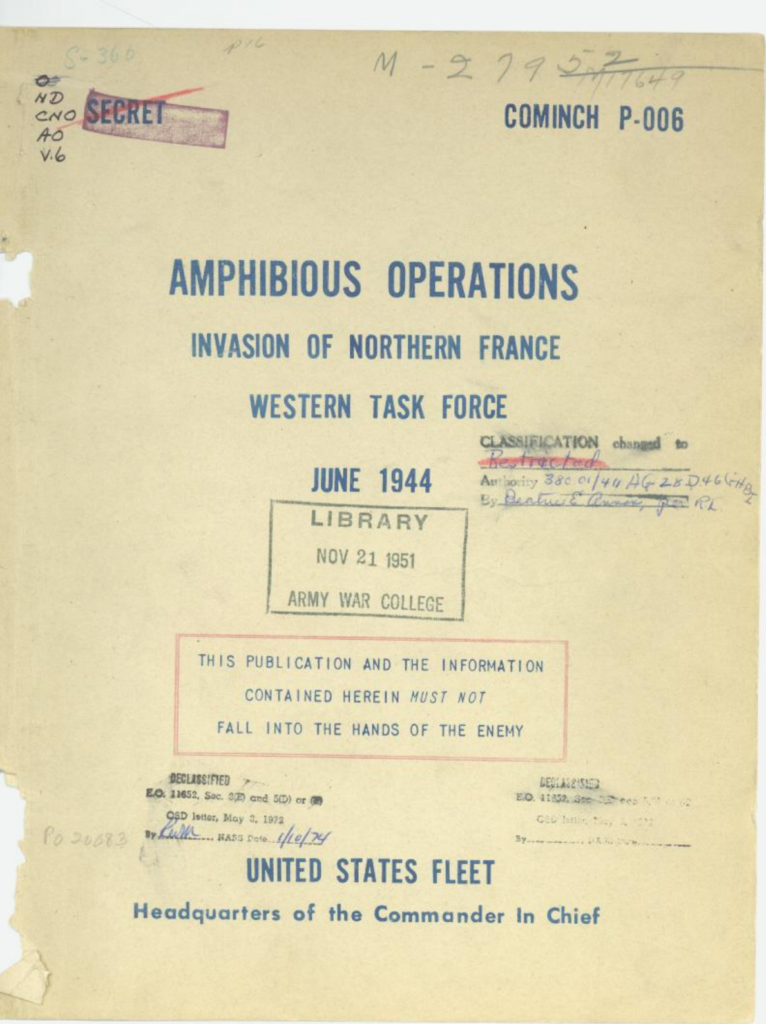
U.S. Navy Report on the D-Day Amphibious Assault and Battle for Omaha Beach (1944)
Key Details
Date: June 1944
Created By: United States Fleet
Original or Replica: Original
Era: The General, D-Day and the Normandy Invasion
Collection: Eisenhower Presidential Library
Citations: Walter Bedell Smith Collection of World War II Documents, Box 48, Eight Air Force Tactical Operations in Support of Allied Landings in Normandy June 2-17 1944 (1); NAID #12005069
About
This secret U.S. Navy report examines the Western Task Force’s amphibious operations during the Normandy invasion, with particular attention to the difficult assault on Omaha Beach on June 6, 1944. The report describes formidable German defenses, including mines, beach obstacles, artillery, machine guns, fortified positions, and troops positioned along terrain overlooking the landing areas. It also explains how rough seas, poor visibility, and the failure of preliminary air and naval bombardment to eliminate many German defenses complicated the assault.
The report follows the landing waves as American infantry, engineers, tanks, and naval forces struggled to establish a foothold. Many landing craft arrived at incorrect locations, specialized tanks were lost offshore, and troops faced intense German fire while attempting to cross the exposed beach. Naval vessels moved dangerously close to shore to provide direct gunfire support against German positions. Despite heavy casualties and confusion, small groups gradually penetrated the defenses and moved inland. By late afternoon, organized German resistance along much of the beach had weakened, allowing additional troops and equipment to come ashore. Photographs throughout the report illustrate landing operations, damaged equipment, beach obstacles, and conditions faced by the assault forces. The document provides a detailed military assessment of why Omaha Beach proved so difficult and how American forces ultimately overcame German defenses to secure the beachhead.
Used In These Lessons & Programs
Bring History to Life
Join us for engaging learning experiences designed for young minds.