Document
Operations Coordinating Board Develops a Strategy to Promote Eisenhower’s Atoms for Peace Proposal (1954)
Key Details
Date: February 4, 1954
Created By: No Author
Original or Replica: Original
Era: The Presidency, The Cold War
Collection: Eisenhower Presidential Library
Citations: C.D. Jackson Papers, Box 29, Atoms for Peace-Evolution (1); NAID #12022773
About
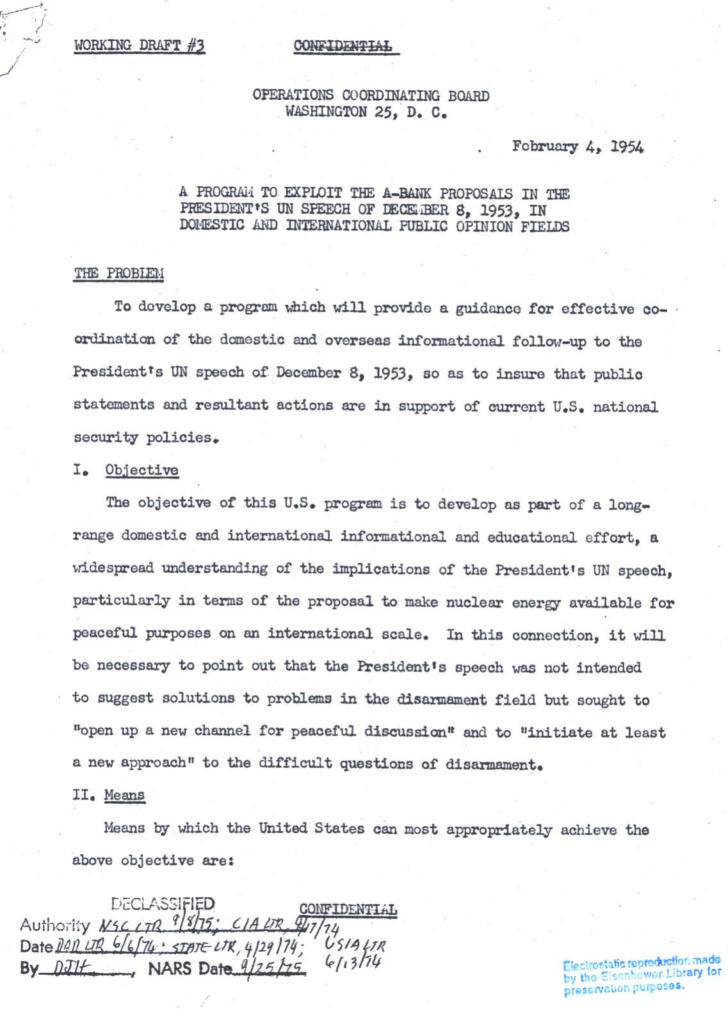
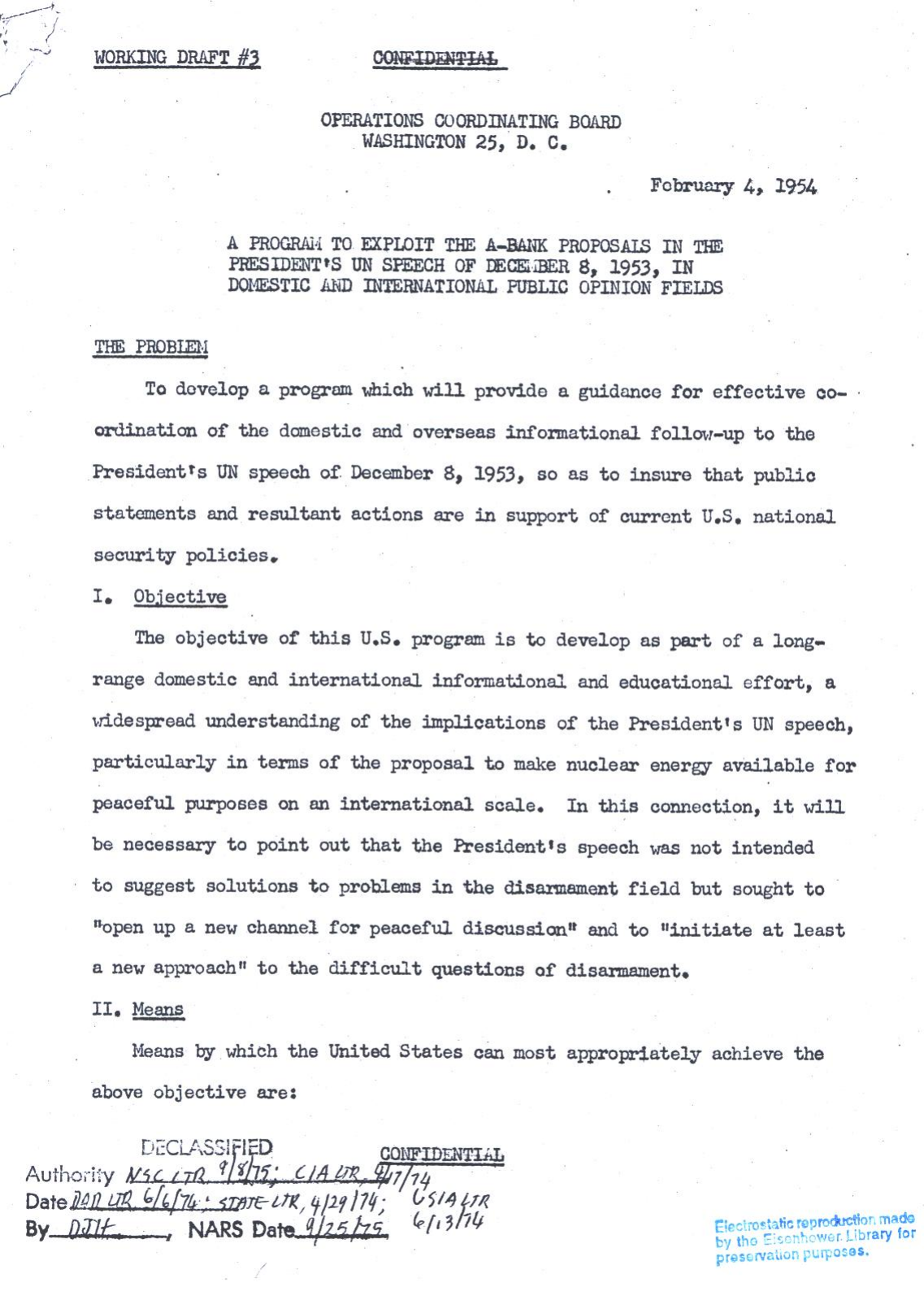
This February 4, 1954 working draft from the Operations Coordinating Board outlines a coordinated domestic and international strategy for promoting President Dwight D. Eisenhower’s Atoms for Peace proposal, announced in his December 1953 address to the United Nations. The document explains that the administration wanted to build widespread understanding of Eisenhower’s proposal to make nuclear energy available for peaceful purposes while emphasizing that the initiative was intended to open new possibilities for international cooperation rather than immediately solve the broader problem of disarmament. It also assesses the initial international response, noting favorable public reaction while anticipating continued Soviet opposition and propaganda attacks against the proposal.
The document recommends turning Eisenhower’s proposal into a sustained program of practical action. Suggested initiatives include establishing an international scientific school in the United States, expanding reporting about peaceful uses of atomic energy, encouraging agricultural, medical, and industrial applications of nuclear technology, increasing the international availability of radioisotopes, and promoting cooperation among scientists. The report stresses that tangible results would strengthen international confidence in the program.
The final section proposes an extensive public-information campaign involving federal agencies, radio and television, films, educational institutions, civic organizations, labor groups, religious organizations, businesses, and agricultural leaders. The document therefore illustrates how the Eisenhower administration sought to transform Atoms for Peace from a presidential speech into a broader Cold War diplomatic, scientific, and public-information initiative.
Used In These Lessons & Programs
Bring History to Life
Join us for engaging learning experiences designed for young minds.