Document
Eisenhower Administration Explains the Purpose and Development of the Atoms for Peace Proposal (1953)
Key Details
Date: December 16, 1953
Created By: No Author
Original or Replica: Original
Era: The Presidency, The Cold War
Collection: Eisenhower Presidential Library
Citations: C.D. Jackson Papers, Box 100, Speech Texts 1953 (1); NAID #12022766
About
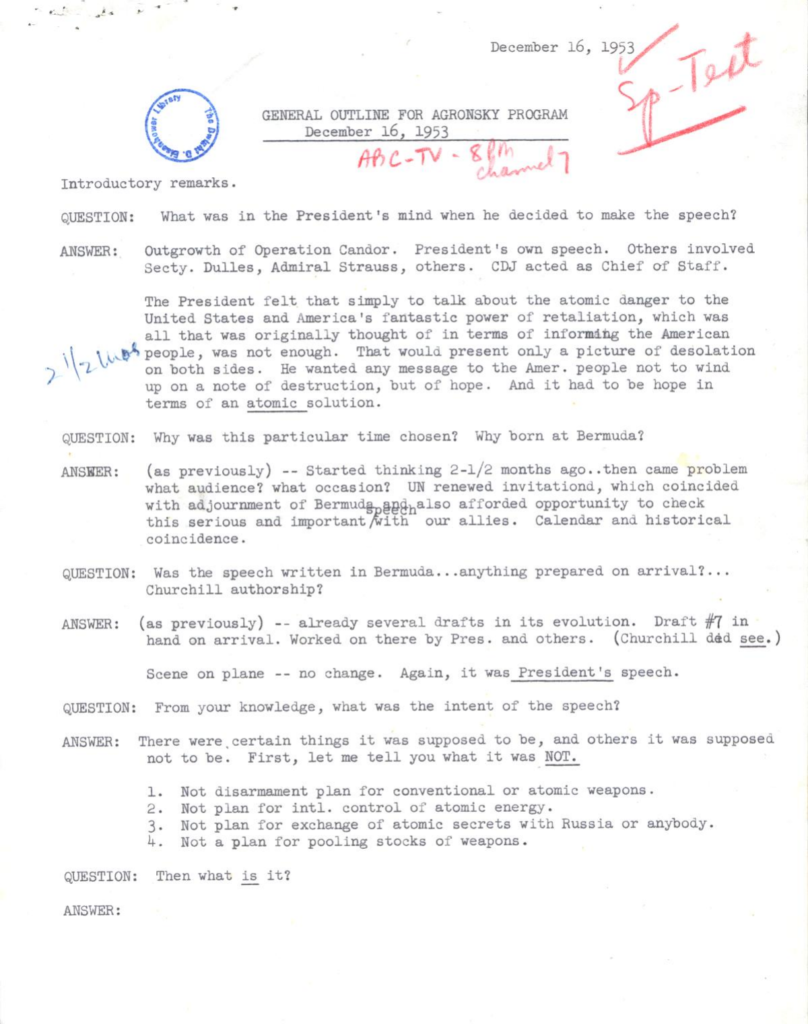
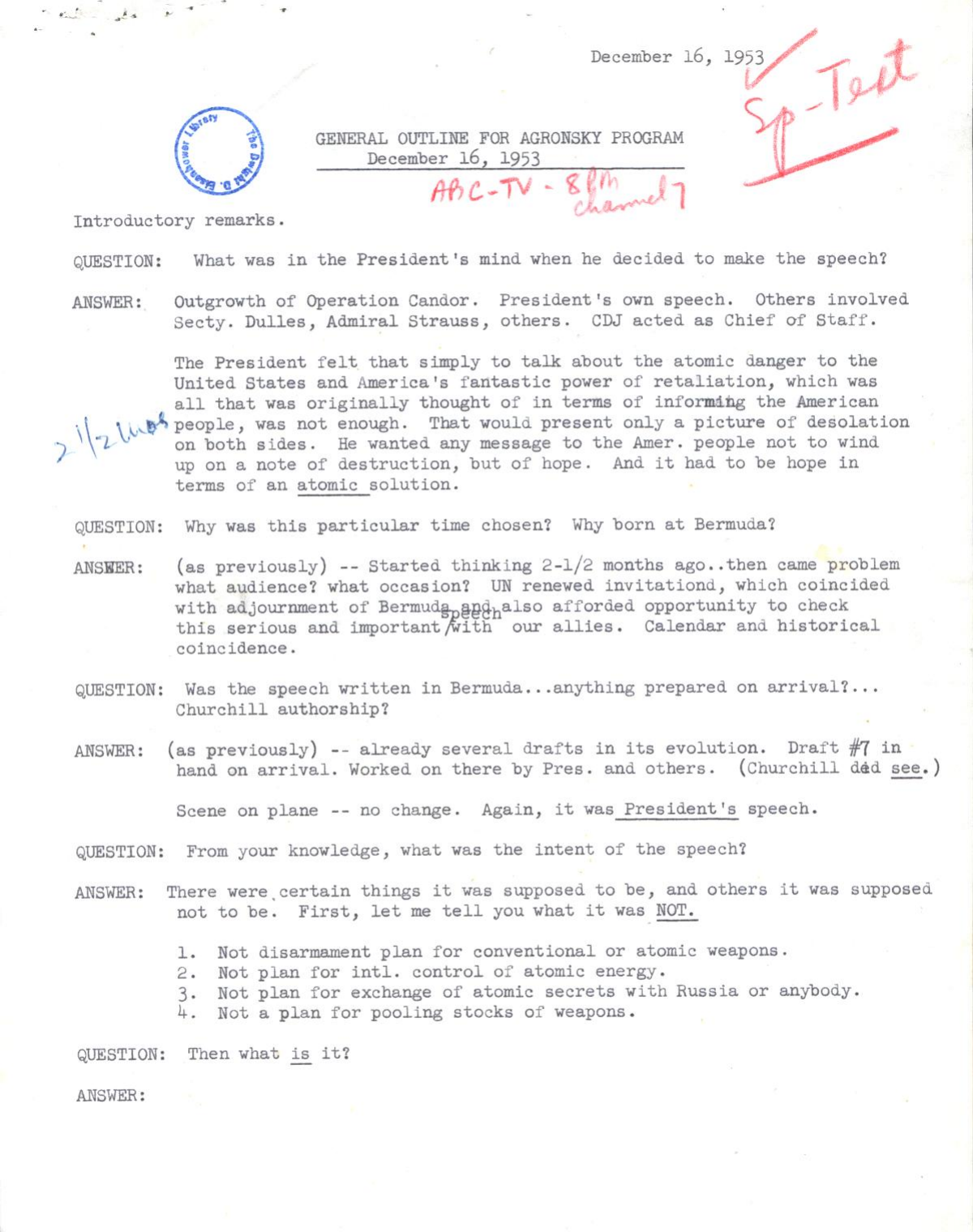
This December 16, 1953 outline for a television interview with journalist Martin Agronsky provides talking points explaining the origins, purpose, and intended meaning of President Dwight D. Eisenhower’s Atoms for Peace proposal, announced before the United Nations eight days earlier. The outline emphasizes that the initiative grew from Operation Candor and Eisenhower’s desire to do more than simply warn Americans about the destructive power of nuclear weapons. Instead, he wanted to offer the public and the world a message of hope centered on a constructive use of atomic energy. The document repeatedly stresses that the address was Eisenhower’s own speech, despite the involvement of Secretary of State John Foster Dulles, Atomic Energy Commission Chairman Lewis Strauss, C. D. Jackson, and others in its development.
The outline carefully explains what Atoms for Peace was not: it was not a conventional or atomic disarmament plan, a system for international control of atomic energy, an exchange of nuclear secrets with the Soviet Union, or a pooling of existing nuclear weapons. Instead, it describes Eisenhower’s proposal as a “small beginning” intended to break the diplomatic deadlock and create a practical area in which the United States and Soviet Union might cooperate. The document insists that the proposal was not intended as psychological warfare against the Soviets but as a genuine and achievable initiative that ordinary people could understand.
The final section places the proposal within the larger Cold War. Rather than attempting to resolve the nuclear arms race and U.S.-Soviet tensions all at once, Eisenhower hoped that successful cooperation in one limited area might lead to further agreements and reveal whether peaceful coexistence with the Soviet Union was ultimately possible.
The document provides a valuable behind-the-scenes explanation of what Eisenhower hoped Atoms for Peace would accomplish and how his administration wanted the public to understand the initiative.
Used In These Lessons & Programs
Bring History to Life
Join us for engaging learning experiences designed for young minds.