Document
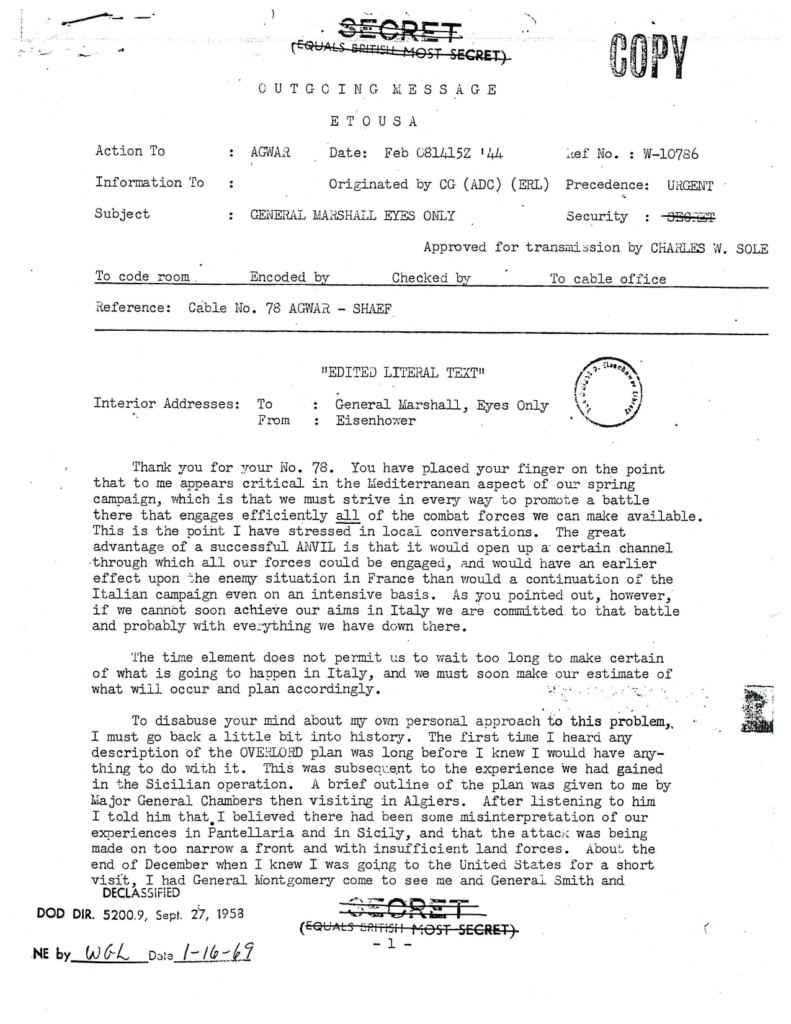
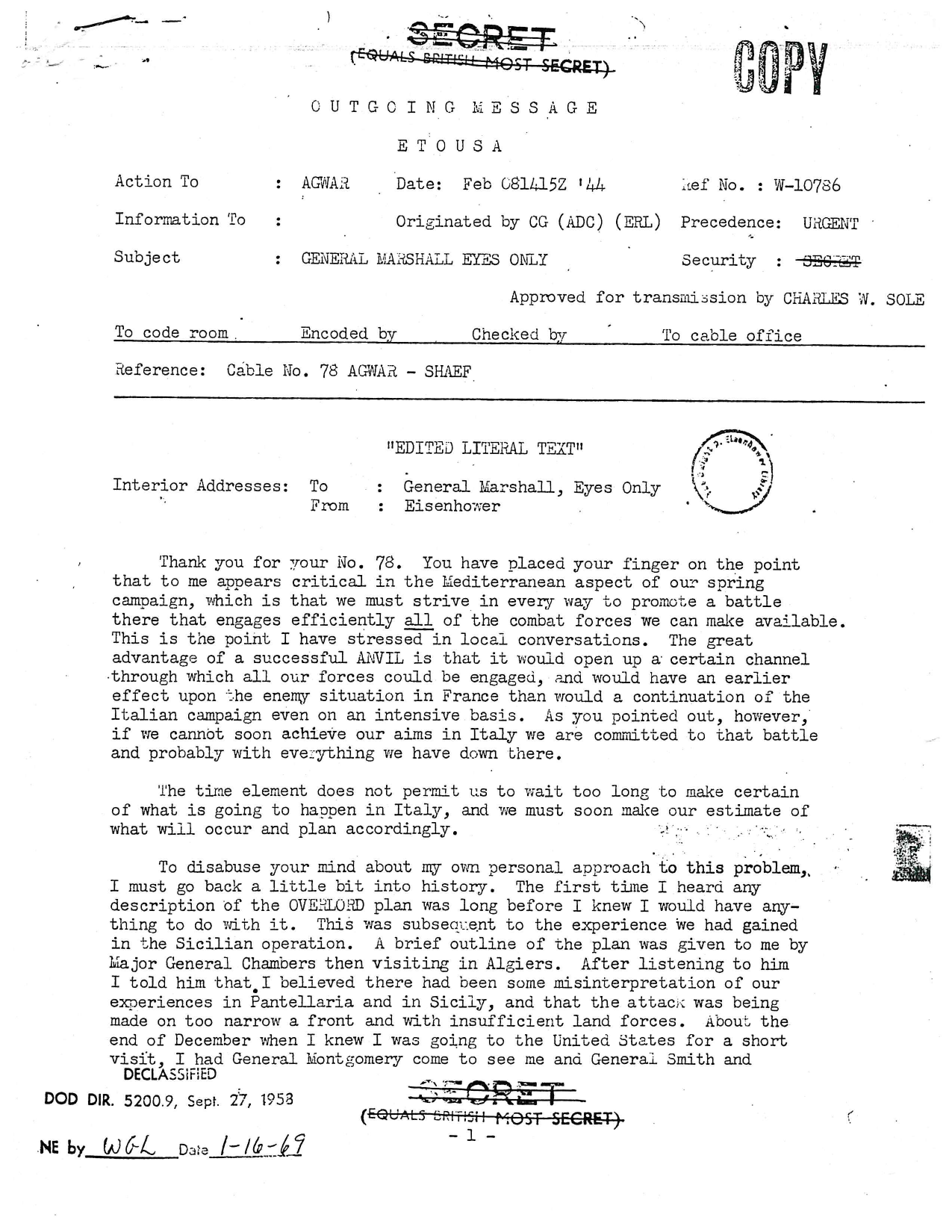
Eisenhower Outlines His Strategy for Operation Overlord and Balancing the Normandy and Italian Campaigns (1944)
Key Details
Date: February 1, 1944
Created By: Dwight D. Eisenhower
Original or Replica: Original
Era: The General, D-Day and the Normandy Invasion
Collection: Eisenhower Presidential Library
Citations: Eisenhower Presidential Library and Museum
About
In this February 1944 secret message to Army Chief of Staff George C. Marshall, General Dwight D. Eisenhower explains his developing strategy for Operation Overlord and how the invasion of France should be coordinated with Allied operations in the Mediterranean. Eisenhower argues that the spring campaign in Italy should force Germany to commit as many troops as possible, thereby preventing those forces from reinforcing France. He stresses the potential value of a successful Anzio operation, but warns that the Allies could not allow continued fighting in Italy to consume resources needed for the cross-Channel invasion.
Eisenhower also explains his thinking about the size and timing of the Normandy assault. Drawing partly on his experience in Sicily, he argues that the original Overlord plan required greater strength. He states his conviction that the initial assault should consist of five divisions heavily reinforced with armor, preceded by approximately two months of intensive air operations. He also calls for at least one full airborne division, possibly reinforced by additional regimental combat teams, and proposes landing two additional reinforced divisions on the second tide of D-Day.
The message demonstrates Eisenhower’s determination to concentrate overwhelming Allied resources behind Overlord while still using Mediterranean operations to tie down German forces. He predicts that from D-Day through approximately D+60, the Normandy campaign would absorb virtually everything the United States and Britain could provide, particularly ground forces, shipping, and tactical air power.
The document provides a valuable look at Eisenhower’s personal strategic thinking as the final shape of the D-Day invasion was being developed.
Used In These Lessons & Programs
Bring History to Life
Join us for engaging learning experiences designed for young minds.