Document
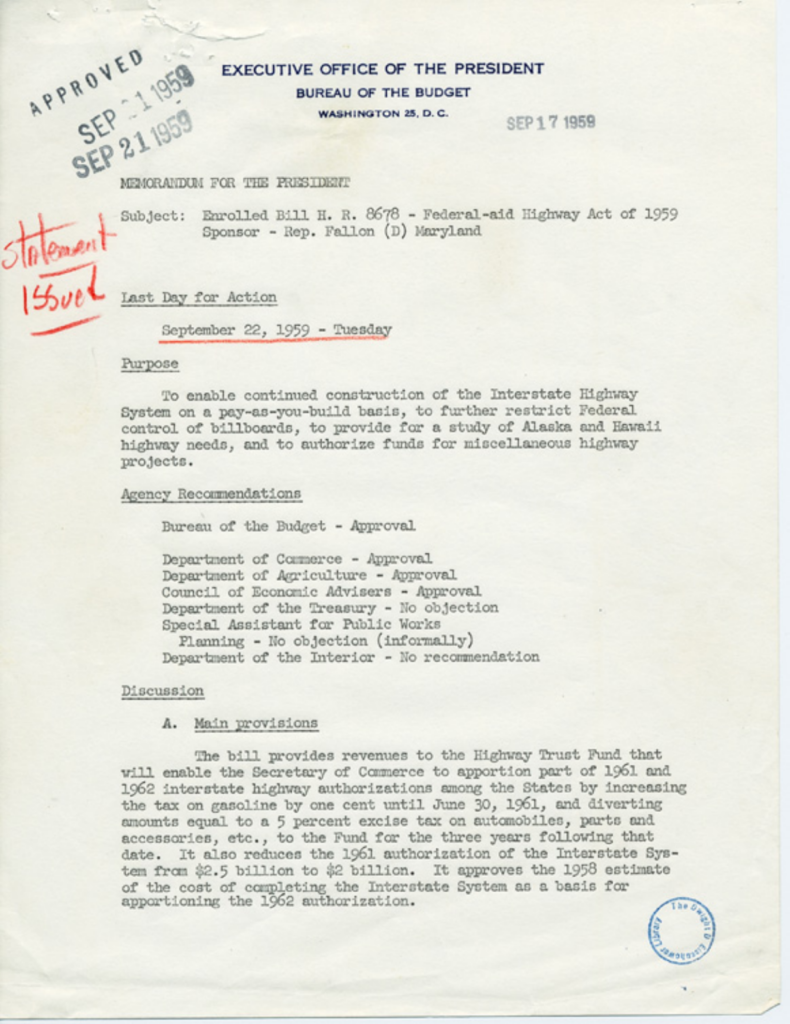
Bureau of the Budget Memorandum Recommending Approval of the Federal-Aid Highway Act of 1959
Key Details
Date: September 17, 1959
Created By: Phillip Hughes
Original or Replica: Original
Era: The Presidency, The Interstate Highway System
Collection: Eisenhower Presidential Library
Citations: White House Office: Record Officer Reports to President on Pending Legislation, Box 159, Appr. 9/21/1959 to amend the Federal Aid Highway Acts of 1956 and 1958 . . .; NAID #16857636
About
This document is a memorandum prepared for President Dwight D. Eisenhower by Philip S. Hughes, Assistant Director for Legislative Reference in the Bureau of the Budget, on September 17, 1959. The memorandum summarizes the provisions of H.R. 8678, the Federal-Aid Highway Act of 1959, and provides recommendations to assist the President in deciding whether to sign the legislation before the September 22 deadline. It also includes the positions of several executive agencies, all of which recommended approval or expressed no objection to the bill.
The memorandum explains that the bill would continue funding for construction of the Interstate Highway System through adjustments to the federal gasoline tax and other Highway Trust Fund revenues. While acknowledging that the legislation did not provide a complete long-term solution to highway financing and would likely delay portions of the Interstate Highway Program, the memorandum concludes that it represented the best compromise available. It also discusses several additional provisions of the bill, including expanded federal billboard regulations, a study of Alaska’s and Hawaii’s highway needs, funding for disaster-related highway repairs, and appropriations for miscellaneous transportation projects. The memorandum recommends that future legislation address the remaining financing challenges facing the Interstate Highway System.
The Interstate Highway System, authorized by the Federal-Aid Highway Act of 1956, became one of President Eisenhower’s signature domestic achievements, transforming transportation, commerce, and national defense in the United States.
Used In These Lessons & Programs
Bring History to Life
Join us for engaging learning experiences designed for young minds.