Document
Eisenhower Administration Plans NASA’s Creation and Debates Which Military Space Programs Should Become Civilian (1958)
Key Details
Date: April 10, 1958
Created By: Robert Piland
Original or Replica: Original
Era: The Presidency, The Space Race
Collection: Eisenhower Presidential Library
Citations: DDE’s Records as President, Confidential File, Box 44, National Aeronautics and Space Administration (1); NAID #12060417
About
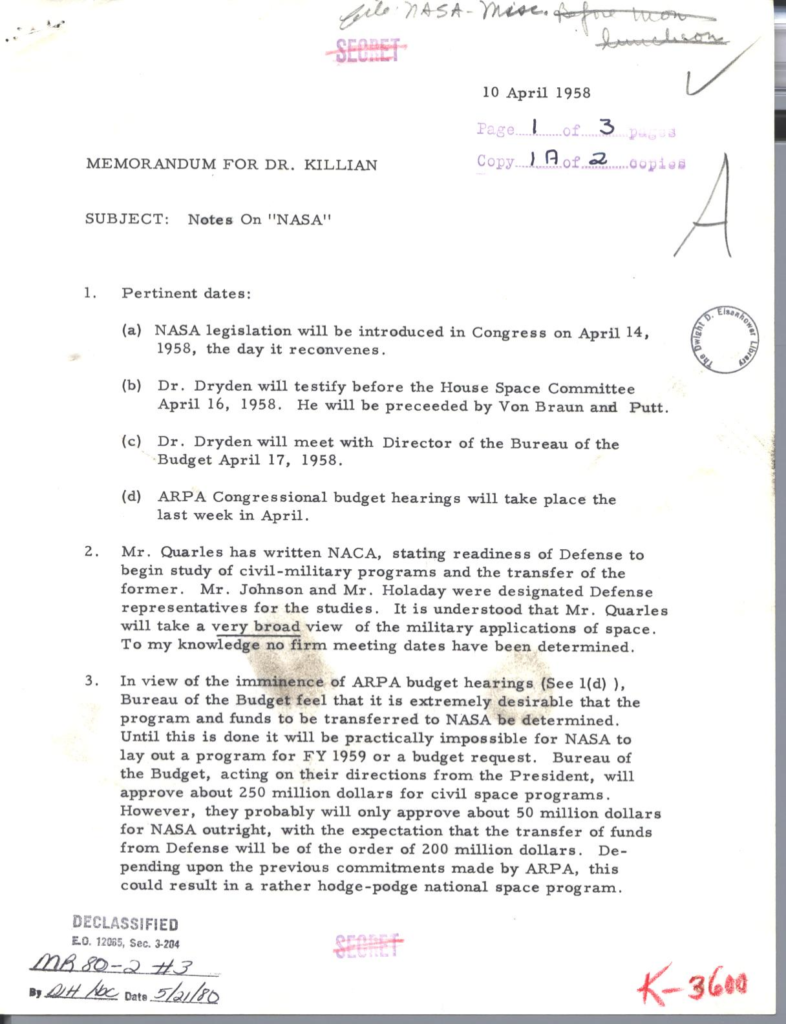
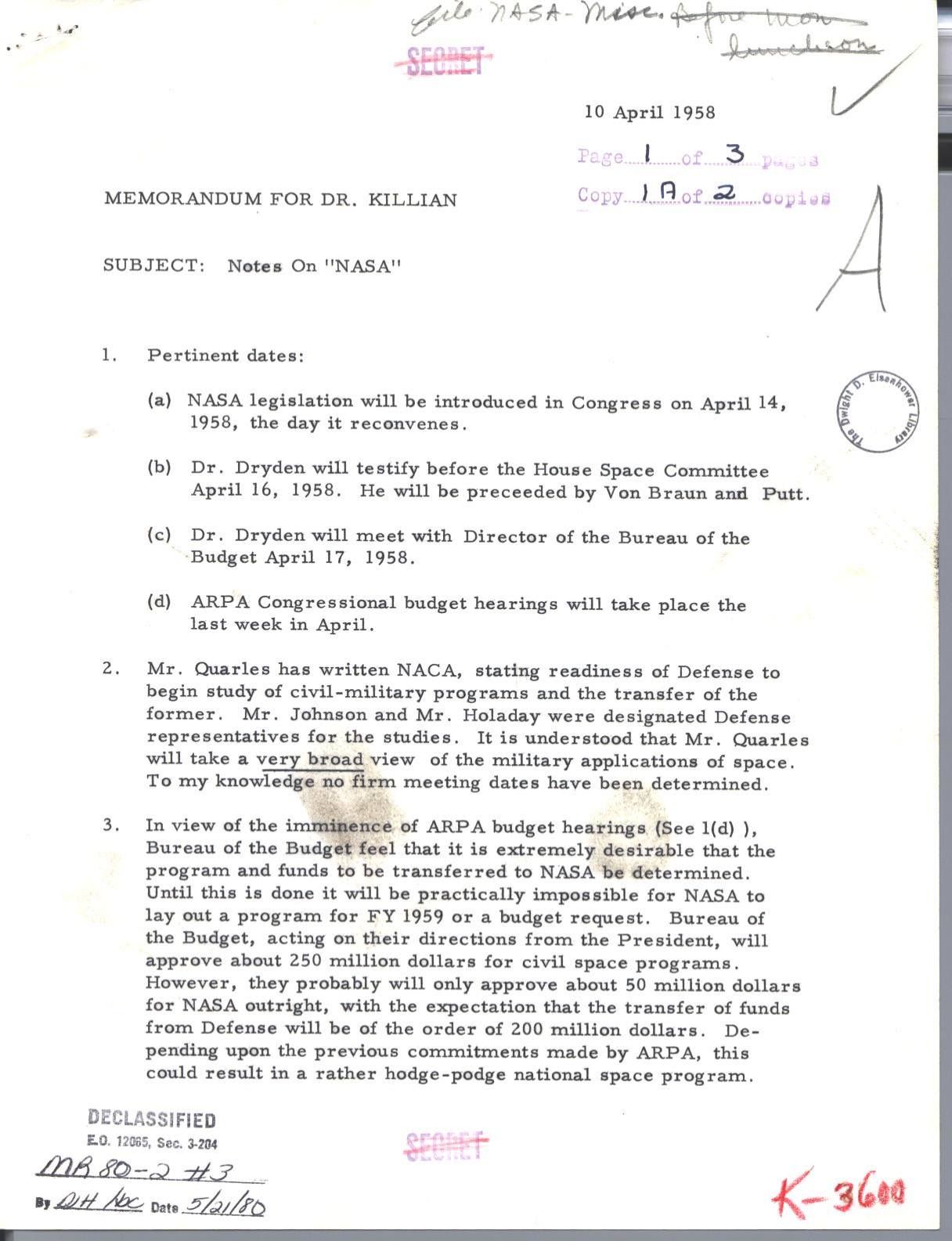
This April 10, 1958 memorandum to Presidential Science Adviser James R. Killian Jr. provides a behind-the-scenes look at the Eisenhower administration’s preparations for creating NASA. Written only months after the Soviet launch of Sputnik, the memorandum notes that legislation establishing the new civilian space agency was scheduled to be introduced in Congress on April 14, 1958. It also describes ongoing discussions over which space programs then controlled by the Department of Defense’s Advanced Research Projects Agency (ARPA) should be transferred to the new agency.
A central issue was determining the proper boundary between civilian and military space activities. The memorandum reviews more than $500 million in ARPA programs, including anti-ICBM research, military reconnaissance satellites, space technology, Explorer satellites, lunar probes, human spaceflight, reentry research, and large rocket engines. Officials believed programs such as Explorer and scientific satellites clearly belonged within the civilian program, while human spaceflight was more controversial because it could serve both civilian exploration and military purposes.
The document also reveals uncertainty over NASA’s initial funding. The Bureau of the Budget anticipated providing approximately $250 million for civilian space programs, with additional resources transferred from Defense. Officials worried that disagreements over which programs and funds NASA would inherit could produce a poorly coordinated national space program.
Significantly, the memorandum notes that some NASA officials believed human spaceflight could generate greater national “prestige” and “propaganda” value than an early lunar program, because existing rocket payload limitations made meaningful lunar missions difficult. It also anticipates that Robert R. Gilruth would lead the human-spaceflight portion of the new organization.
The document provides a valuable look at NASA while it was still being designed, revealing the debates over funding, military versus civilian responsibilities, human spaceflight, and national prestige that helped shape America’s response to the Soviet challenge in space.
Used In These Lessons & Programs
Bring History to Life
Join us for engaging learning experiences designed for young minds.