Document
Science Adviser James Killian Reports to Eisenhower on Early U.S. Satellite Discoveries and the Hazards of Space Travel (1958)
Key Details
Date: August 23, 1958
Created By: Dr. J.R. Killian
Original or Replica: Original
Era: The Presidency, The Space Race
Collection: Eisenhower Presidential Library
Citations: DDE’s Papers as President, Administration Series, Box 23, James R. Killian 1957 (2); NAID #12042594
About
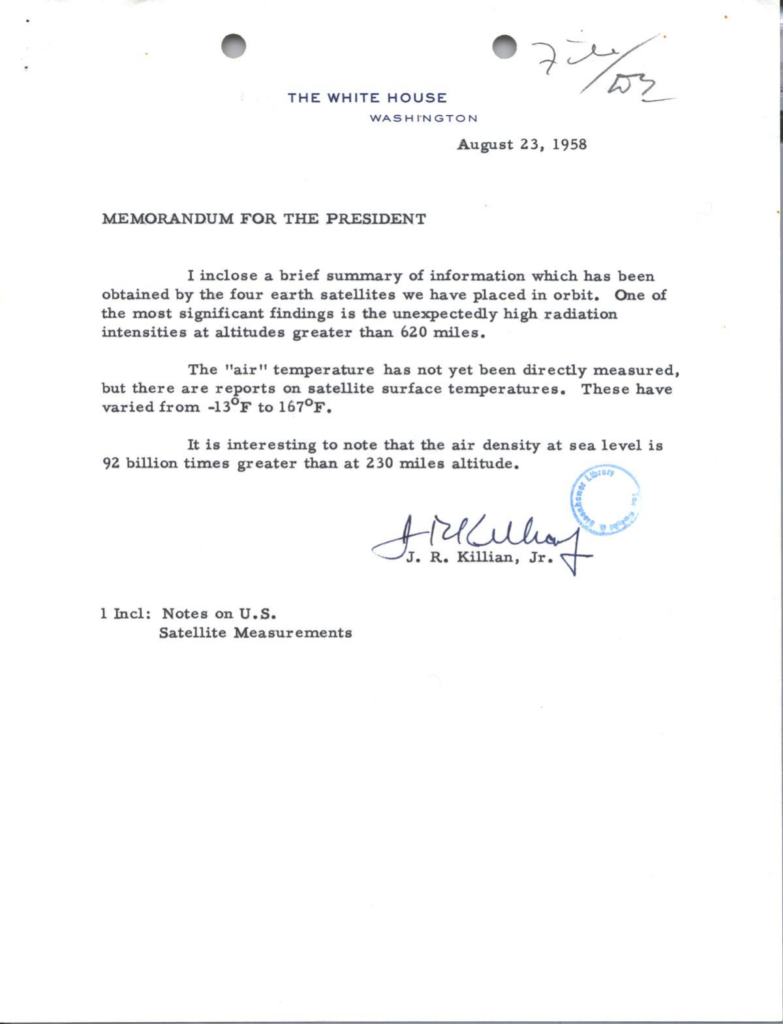
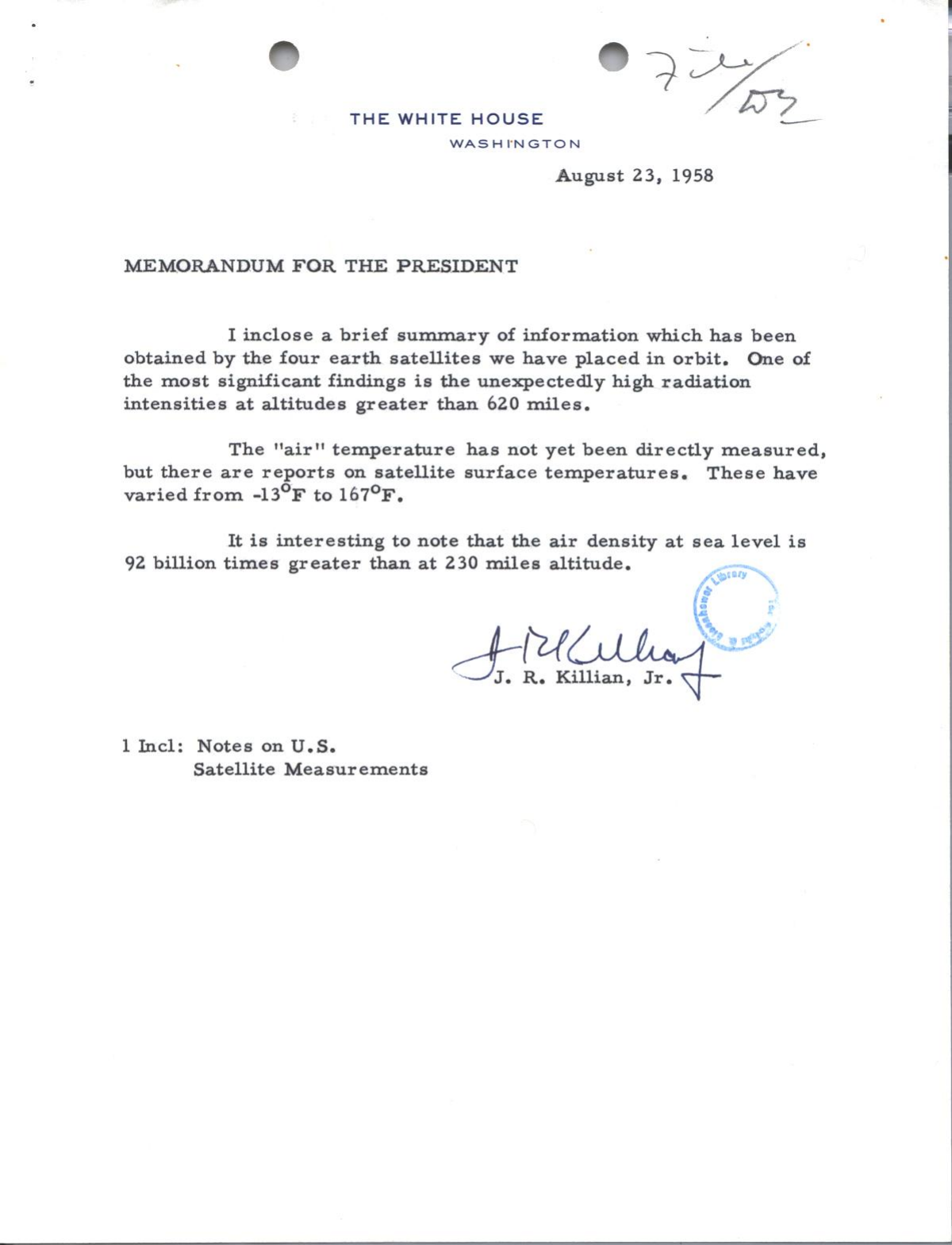
In this August 23, 1958 memorandum to President Dwight D. Eisenhower, Presidential Science Adviser James R. Killian Jr. summarizes scientific information gathered from the first four successful American Earth satellites: Explorer I, Explorer III, Explorer IV, and Vanguard I. The accompanying report reviews what these early satellites had revealed about radiation, temperature, micrometeorites, and the extremely thin atmosphere at high altitudes. Killian particularly emphasizes the unexpected discovery of very high radiation levels above approximately 620 miles, one of the most important findings of the early American space program.
Measurements from the Explorer satellites showed radiation increasing dramatically with altitude. The report estimates that at 1,000 miles the radiation exposure could reach two roentgens per hour, compared with a permissible human exposure rate cited in the document of approximately .002 roentgens per hour. Although the report states that these findings did not rule out human spaceflight, they demonstrated that adequate radiation shielding would be essential.
The report also examines the engineering challenges of operating satellites in space. Satellite surface temperatures ranged from approximately –13°F to 167°F, requiring careful management of heat from solar and terrestrial radiation. Explorers I and III also measured micrometeorite impacts, while tracking data allowed scientists to calculate atmospheric density at altitudes previously difficult to study.
The document provides a valuable snapshot of America’s rapidly developing understanding of space only months after Explorer I became the first successful U.S. satellite. It demonstrates how early satellite missions were already producing discoveries with major implications for spacecraft design, scientific research, and the possibility of future human spaceflight.
Used In These Lessons & Programs
Bring History to Life
Join us for engaging learning experiences designed for young minds.