Document
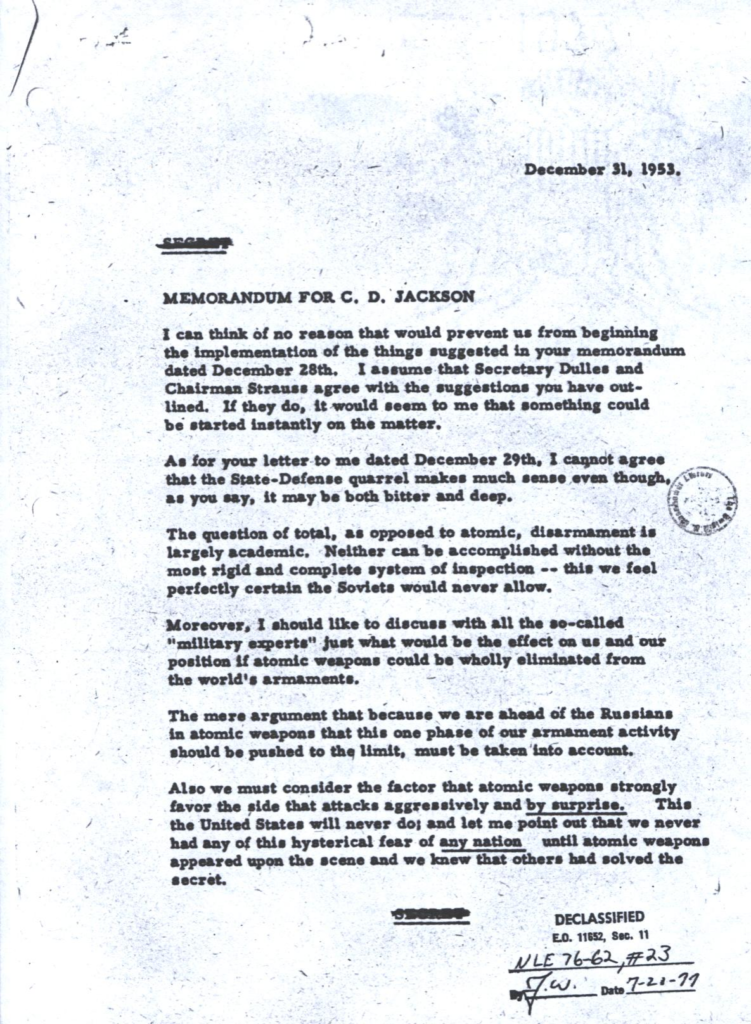
Eisenhower Questions Nuclear Disarmament and Orders Further Study of America’s Atomic Strategy (1953)
Key Details
Date: December 31, 1953
Created By: Dwight D. Eisenhower
Original or Replica: Original
Era: The Presidency, The Cold War
Collection: Eisenhower Presidential Library
Citations: DDE’s Papers as President, DDE Diary Series, Box 4, DDE Diary December 1953 (1); NAID #12022923
About
In this December 31, 1953 memorandum to presidential adviser C. D. Jackson, President Dwight D. Eisenhower discusses the next steps following his recently announced Atoms for Peace initiative and raises broader questions about American nuclear strategy. Eisenhower supports immediately beginning the implementation of recommendations Jackson had made in an earlier memorandum, provided Secretary of State John Foster Dulles and Atomic Energy Commission Chairman Lewis Strauss agreed. However, Eisenhower expresses reservations about Jackson’s argument concerning a possible State-Defense position on disarmament.
Eisenhower argues that total disarmament, as opposed to specifically atomic disarmament, was largely unrealistic because any meaningful agreement would require an extremely strict international inspection system that he believed the Soviet Union would never accept. He also questions what would happen to the strategic position of the United States if atomic weapons were completely eliminated from the world’s arsenals. Although the United States held an advantage over the Soviet Union in nuclear weapons, Eisenhower warns that this fact alone should not determine American policy.
Of particular concern to Eisenhower was the possibility that nuclear weapons favored a nation willing to launch an aggressive surprise attack. Rather than accepting a predetermined position, he calls for a deeper intellectual examination of the problem. He asks Jackson to arrange a meeting with Dulles, Secretary of Defense Charles Wilson, Strauss, and himself to discuss the issue.
The memorandum provides a revealing look at Eisenhower’s thinking about nuclear deterrence, disarmament, and Soviet intentions shortly after his Atoms for Peace speech.
Used In These Lessons & Programs
Bring History to Life
Join us for engaging learning experiences designed for young minds.